

There is a particular kind of exhaustion that has no medical name. You sleep eight hours and still wake up tired. You eat, rest, and exercise — yet something inside you stays depleted. Doctors find nothing wrong. But something is very wrong, and it has a face, a voice, and usually a key to your house or a seat at your table.
Toxic people do not always arrive with warning labels. They come wrapped in charm, in shared history, in love that feels real until it costs you everything. The damage they cause is not always visible in bruises or broken objects — it lives in the way you second-guess yourself before speaking, in the apologies you issue for things that were never your fault, in the shrinking that happens so gradually you mistake it for personal growth.
This collection of 250+ realistic toxic people quotes was built differently. Every quote here is long enough to mean something, specific enough to be recognized, and honest enough to reach the part of you that has been wondering whether what you experienced was actually real. It was. These words are here to confirm it.
Whether you are currently inside a toxic dynamic, carefully distancing yourself, or standing on the other side of one wondering how you survived — this collection sees you.
People search for toxic quotes for very different reasons — some want words to process what they are living through, others want toxic quotes to send to a friend who needs to hear it, and some simply want a private reminder saved on their phone. Whatever the reason, these toxic quotes are written to be specific enough to recognize and honest enough to sit with.
Part 1: Quotes That Capture the Slow Realization of Toxicity
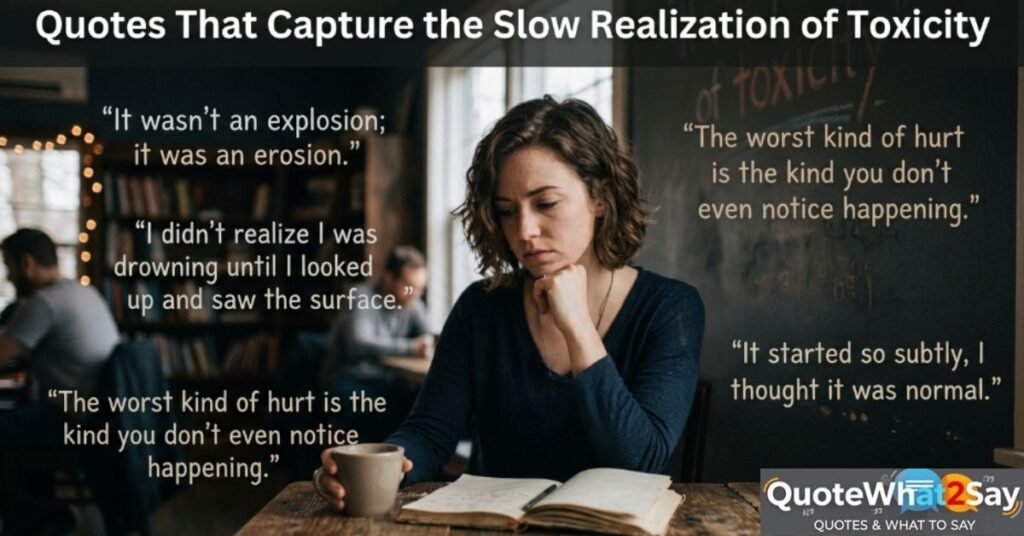
The most disorienting thing about toxic relationships is not the harm itself — it is the delay between when the harm begins and when you finally recognize it. These quotes are for that specific, unsettling moment when something inside you quietly says: this is not okay, and it has not been okay for a long time.
- You do not notice the water rising when you have been standing in it long enough to call it home.
- The day you realize the exhaustion is not about the workload but about one specific person — that is the day everything starts to make sense.
- Toxic people rarely announce themselves. They introduce themselves as the solution before revealing they were always the problem.
- There is a particular confusion that only comes from caring deeply about someone who is quietly dismantling you.
- You spend months thinking something is wrong with you, and then one clear morning you understand that nothing was ever wrong with you at all.
- The most unsettling realization is not that someone hurt you — it is that they knew they were hurting you and continued anyway.
- Normalizing dysfunction is not the same as accepting it. Your nervous system always knew the difference, even when your mind argued otherwise.
- When you stop excusing someone’s behavior and start examining it, the picture becomes impossible to ignore.
- The erosion happens in small moments — a dismissal here, a subtle jab there — until one day you cannot remember the last time you felt genuinely at ease around them.
- Recognizing toxicity is not a betrayal of the relationship. It is the first honest thing you have done inside it.
- The problem with being perceptive around toxic people is that you spend more energy questioning your perceptions than they spend correcting their behavior.
- Some people leave you more tired after a conversation than you were after a twelve-hour shift. That gap is data worth examining.
- You kept finding reasons to explain their behavior until you ran out of reasons and were left only with the pattern.
- The moment you stop defending them to yourself is the moment the healing process quietly begins.
- Toxicity does not always scream. Most of the time it whispers, and it sounds exactly like your own self-doubt.
Part 2: Toxic People and Manipulation — Quotes That Name It Accurately
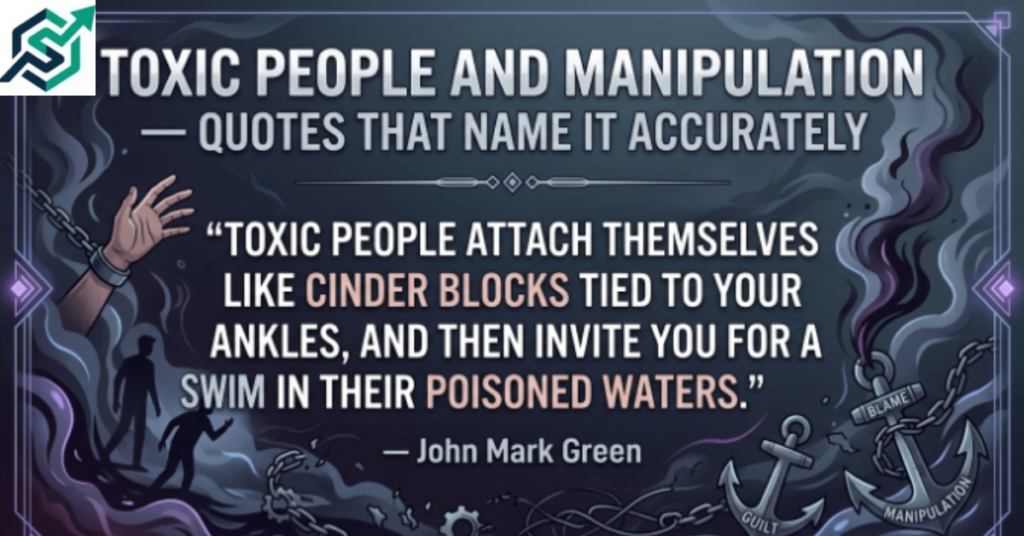
Manipulation is sophisticated. It rarely looks like manipulation from the inside — it looks like love, concern, helpfulness, or loyalty. These quotes exist to name the tactics clearly, not to assign blame, but to restore clarity to people who have been living inside deliberate confusion.
- A manipulator’s greatest tool is making you believe that your reaction to their behavior is the actual problem.
- Gaslighting does not feel like someone lying to you. It feels like your own memory betraying you — and that is precisely what makes it so effective.
- Toxic control does not always look like aggression. Sometimes it looks like someone who is endlessly, suffocatingly helpful.
- When someone consistently makes you feel grateful for treatment that is merely adequate, manipulation is already well underway.
- The most skilled manipulators never ask for anything directly. They create situations in which the only reasonable response is to give them what they want.
- Emotional manipulation works because it exploits the most decent parts of you — your empathy, your guilt, your loyalty, your desire to be fair.
- When someone weaponizes your vulnerability against you, the wound is doubled: once for the original pain and once for the betrayal of trust.
- DARVO — deny, attack, reverse victim and offender — is a pattern so reliable it was given a clinical name. If it sounds familiar, you are not imagining things.
- The silent treatment is not maturity. It is control dressed in the language of emotional restraint.
- Love bombing followed by withdrawal is not a personality quirk. It is a cycle, and cycles are not accidents.
- When someone consistently reframes your legitimate concerns as character flaws, they are not trying to understand you. They are trying to manage you.
- A person who always has an explanation that perfectly positions them as innocent and you as the problem has likely rehearsed that explanation.
- Emotional manipulation leaves no fingerprints. That is why so many victims spend years wondering whether anything actually happened.
- The moment you express a need and the conversation somehow ends with you comforting them, you are inside a manipulative dynamic.
- Manipulation thrives in the gap between what someone says and what they consistently do. Watch the gap.
Part 3: Quotes About Fake Love and Conditional Affection
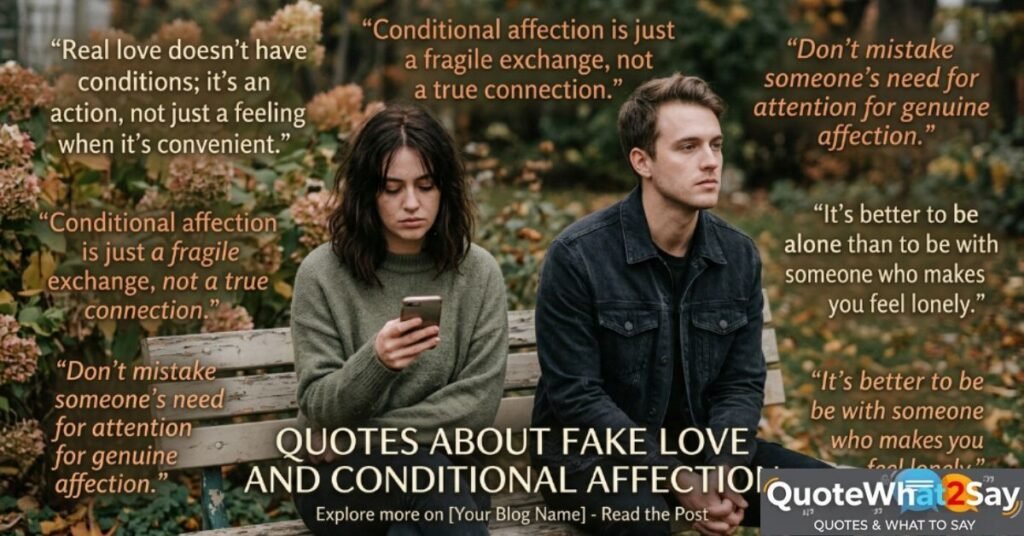
Conditional love is arguably more painful than its absence, because you experience the warmth of it before discovering the price tag. These toxic relationship quotes are for everyone who loved genuinely and discovered, slowly, that what was returned was performance.
- The cruelest thing about conditional love is that it feels indistinguishable from real love — until the moment you stop meeting the conditions.
- When affection disappears the moment you stop being useful, what you experienced was not love. It was a transaction with emotional packaging.
- Fake love is consistent until it isn’t, warm until it needs something, present until the inconvenience outweighs the benefit.
- You can love someone genuinely while they love only the version of you that requires nothing from them.
- Real love does not require you to shrink yourself to a size that fits their comfort zone.
- The lie was not in the words — the words were often beautiful. The lie lived in the space between what was said and what was actually done.
- Loving someone who only loves you conditionally is like watering a plant that has already decided not to grow.
- When someone says “I love you” but means “I love what you do for me,” the eventual confusion is not a misunderstanding. It is the logical conclusion.
- Affection that disappears during conflict was never unconditional to begin with.
- The most painful kind of fake love is the kind that was real for them in the beginning — and then became a habit they no longer examined.
- You deserved someone whose love did not come with a list of invisible requirements that changed without notice.
- Conditional affection trains you to earn what should be freely given, and the training is extremely difficult to unlearn.
- When someone uses the phrase “you know I love you” as a preface to something unkind, the love and the unkindness are not separate events.
- False intimacy is built from shared secrets, not shared values — and the difference becomes catastrophic when crisis arrives.
- You were not too sensitive. You simply noticed that the love being offered came with conditions you never agreed to.
Looking for the opposite of conditional love? Read our 90 Secret Love Quotes That Speak From the Heart for words about love that asks for nothing in return.
Part 4: Toxic Friendships — Quotes That Describe the Quiet Betrayal
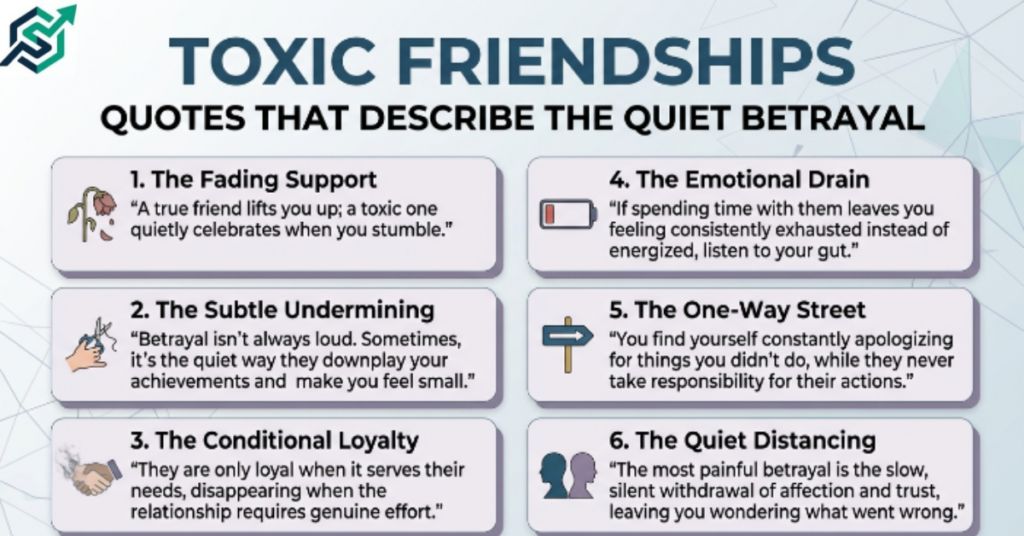
Toxic friendships occupy a uniquely painful territory because society rarely validates the grief of them. There is no formal ritual for mourning a friendship, no socially accepted language for what happens when someone you called a best friend turns out to have been quietly undermining you for years.
- Toxic friendships rarely involve obvious cruelty. They involve someone who celebrates your failures with the same energy they bring to your successes — except the energy feels different each time.
- The friend who is always the first to know your problems but the last to acknowledge your growth is not invested in you. They are invested in your difficulty.
- A friendship built on one person’s constant availability and another person’s constant need is not friendship. It is an arrangement with a loyalty imbalance.
- When your achievements make a friend quiet and your setbacks make them suddenly talkative, their loyalty was always to your lesser version.
- The subtle cruelty of a toxic friend is that they make you feel chosen — until the moment you outgrow what they needed you to be.
- A friend who requires you to diminish yourself to preserve the friendship is asking for something friendship was never designed to cost.
- Toxic friendships teach you to confuse familiarity with safety. The two are not the same thing.
- When you notice that every conversation ends with you feeling smaller than when it began, the problem is not your insecurity — it is the conversation.
- Some friendships survive only because one person keeps forgiving what the other person keeps repeating.
- The absence of a dramatic falling-out does not mean a friendship was healthy. Some toxic friendships simply dissolve because the healthier person quietly stopped accepting less.
- Backhanded compliments are not accidental. They are a form of criticism that maintains plausible deniability.
- A friend who never celebrates your wins without qualification was never truly in your corner.
- You are not obligated to maintain a friendship simply because of how long it has existed. Duration is not the same as quality.
- When a friend’s advice consistently leads you toward their convenience rather than your wellbeing, the advice is not actually about you.
- Some of the loneliest moments in life happen inside friendships that look fine from the outside but feel hollow from within.
Part 5: Toxic Family Members — When Blood Does Not Mean Safe

Family toxicity is among the most complex emotional territory a person can navigate, because it comes loaded with cultural obligation, shared history, and the deeply human belief that family is supposed to be safe. These quotes acknowledge what happens when that belief collides with reality.
- The fact that someone is family does not automatically make them safe, and the fact that they are not safe does not make you a bad family member for acknowledging it.
- Toxic family dynamics are especially durable because they are disguised as tradition, as love, as “that’s just how we are.”
- Growing up inside dysfunction normalizes it so completely that recognizing it as an adult requires unlearning what you spent a childhood learning to accept.
- Blood relation does not create emotional debt. You are not required to maintain access to people who harm you simply because you share a surname.
- The most painful family wounds are the ones that happen repeatedly in the exact same way, by the exact same person, with the exact same lack of accountability.
- When a family member consistently positions themselves as the victim of your boundaries, they are revealing their expectation that you exist without them.
- Generational trauma does not excuse current behavior. Understanding where harm came from does not obligate you to continue receiving it.
- The guilt of distancing from family is real, but it is not always a signal that you are doing something wrong — sometimes it is simply the price of doing something necessary.
- A family that weaponizes loyalty to prevent accountability is not a healthy family system. It is a closed system designed to protect the harmful people within it.
- You can love someone deeply and still recognize that their presence in your life costs more than your wellbeing can afford.
- The enmeshment in toxic family systems is so complete that having your own thoughts and feelings can feel like an act of betrayal.
- Protecting yourself from a toxic family member is not the same as abandoning family. It is refusing to allow family to become the context in which you are harmed.
- When family meetings are consistently about managing one person’s reactions rather than connecting with each other, the dynamic has long since stopped being about family.
- Children raised in toxic family systems often become adults who are fluent in other people’s emotions and illiterate in their own.
- Choosing peace over proximity to family members who harm you is not a decision made lightly. It is made carefully, painfully, and usually after every other option has been exhausted.
Part 6: Quotes About Emotional Drainage and Invisible Exhaustion
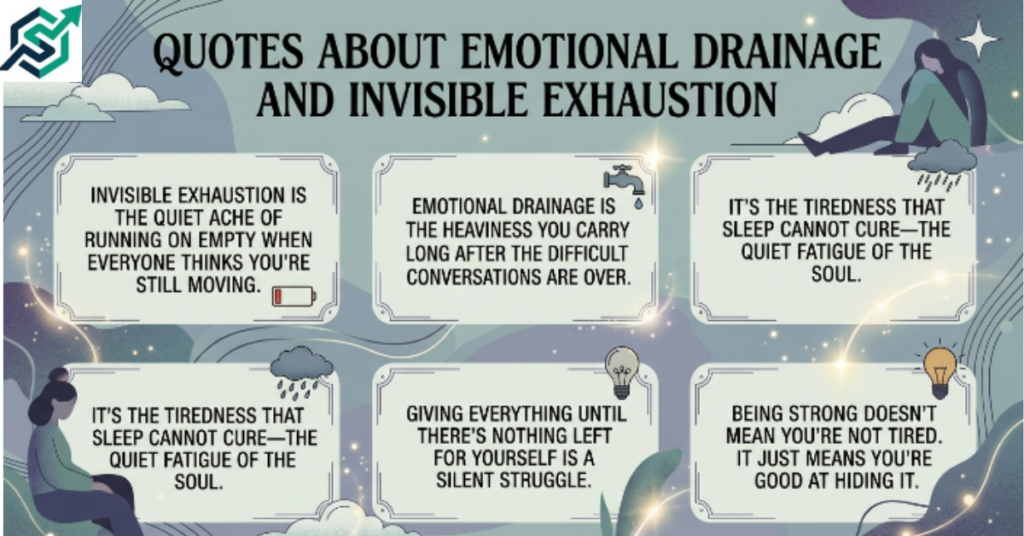
One of the most underreported symptoms of toxic relationships is a specific kind of fatigue that rest does not fix. These quotes name the invisible exhaustion that accumulates inside relationships where emotional labor flows entirely in one direction.
- There is a kind of tiredness that only happens around specific people — and it is trying to tell you something important.
- Emotional labor is real labor. When it is consistently unreciprocated, it becomes exploitation with a relational facade.
- You should not have to recover from spending time with the people you love.
- The most draining relationships are not the ones involving open conflict — they are the ones where you must carefully manage your every word to prevent a reaction.
- Walking on eggshells is exhausting not because of the care required, but because the care should never have been necessary.
- When you spend more energy managing someone else’s emotional state than attending to your own, you have quietly stopped being a participant in the relationship and become its caretaker.
- Emotional dumping is not the same as vulnerability. One is an invitation to connection; the other is a transfer of weight without consent.
- The people who take the most emotional energy are often the ones who would respond with the most offense if you named the cost.
- Hypervigilance in relationships is not a personality trait. It is a response that developed because something in the environment taught you to stay alert.
- Being chronically tired after social interaction is not introversion. Sometimes it is your nervous system’s honest accounting of what certain relationships actually cost.
- One-sided relationships are not relationships. They are emotional subsidy arrangements where one person gives and another person receives and both call it connection.
- The moment you notice yourself rehearsing conversations before having them — choosing every word to minimize their reaction — you are already inside an exhausting dynamic.
- Chronic emotional caretaking without reciprocity does not create closeness. It creates resentment that politely pretends to be love.
- You deserve relationships that restore you, not relationships that require constant energy expenditure just to remain tolerable.
- Exhaustion is sometimes your body’s way of enforcing the boundary your mind has not yet given itself permission to set.
Part 6.5: Toxic Workplace and Toxic Job Quotes
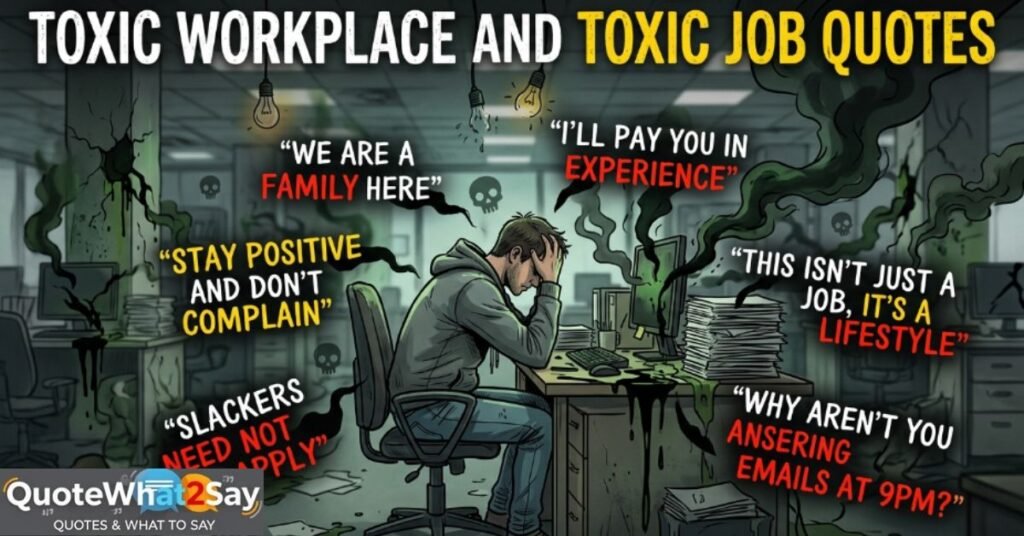
Not every toxic relationship happens at home. Some of the most draining dynamics exist between nine and five, disguised as professionalism. These toxic quotes are for anyone counting down the days until they can leave a job that costs more than it pays.
- A toxic workplace does not always look like yelling. Sometimes it looks like a calendar full of meetings and a culture with no room for honesty.
- The paycheck was never meant to cover the cost of your peace of mind.
- A boss who takes credit for your work and distance from your mistakes is not building a team — they are building a shield.
- You can be excellent at your job and still recognize that the environment around it is slowly wearing you down.
- The healthiest career decision is sometimes the one that looks the least ambitious on paper: leaving.
- No promotion is worth the version of yourself you lose staying somewhere that does not respect you.
- A toxic coworker does not need a title to make an entire team dysfunctional.
- When burnout is treated as a personal failing instead of a systemic problem, the workplace itself is the toxic quote come to life.
- You are allowed to outgrow a job the same way you are allowed to outgrow a person.
- The exhaustion of a toxic workplace does not stay at the office. It follows you home, into your relationships, and into your Sunday nights.
Part 7: Jealousy and Insecurity Disguised as Concern

Jealousy in toxic people rarely announces itself clearly. It arrives wrapped in unsolicited advice, timely discouragement, and a pattern of being most present in your life at the moments when your light is brightest. These quotes decode that pattern.
- Toxic jealousy does not say “I envy you.” It says “Are you sure that’s a good idea?” at exactly the wrong moment.
- The person who consistently finds a reason to qualify your success has a complicated relationship with your happiness that has nothing to do with you.
- Insecurity that has not been examined becomes a weapon aimed at the closest available target — which is usually the person who least deserves it.
- There is a specific kind of person who responds to your good news with a story about themselves. The story is not a coincidence. It is a redirect.
- When someone is consistently more animated in your failure than in your success, their investment in you was never about your wellbeing.
- Toxic jealousy rarely appears as hostility. More often it looks like concern, caution, or the well-intentioned suggestion that you not get too far ahead of yourself.
- The people most threatened by your growth are often the ones who benefit most from you staying exactly where you are.
- Jealousy in a toxic person looks like expertise in everything you attempt, a problem with every plan you share, and mysteriously good advice that always leads you back to their level.
- Insecure people do not want to catch up — they want to pull even. And when they cannot, they redirect their energy toward bringing you back down.
- The most sophisticated jealousy comes from people who would pass any sincerity test — because even they are not fully aware of what is driving their behavior.
Part 8: Quotes About Setting Boundaries Without Guilt

Boundaries are the most misunderstood concept in emotional health. They are not walls. They are not punishments. They are the honest articulation of what you need in order to remain present in a relationship without harming yourself. These quotes make that case.
- A boundary is not an ultimatum. It is a statement about what you are willing to do, not a demand about what they must do.
- The guilt you feel when setting a boundary is often evidence of how long you waited to set it, not evidence that you are wrong to set it now.
- When someone reacts to your boundary with outrage, they are not revealing how unreasonable your boundary is — they are revealing how much they relied on you not having one.
- Boundaries are not about controlling other people. They are about being honest with yourself about what you will and will not continue to accept.
- The people who respect you will respect your limits. The people who argue with your limits are telling you something important about their respect for you.
- Setting a boundary will sometimes feel like abandonment to people who have been counting on your unlimited availability.
- You do not owe anyone an explanation for a boundary. The boundary is sufficient. The explanation is optional.
- Healthy relationships do not require you to justify your needs before your needs are taken seriously.
- The discomfort of setting a boundary is temporary. The cost of not setting one accumulates indefinitely.
- When you set a limit and it ends the relationship, the limit did not end the relationship — the other person’s inability to respect it did.
Part 8.5: Toxic Positivity Quotes
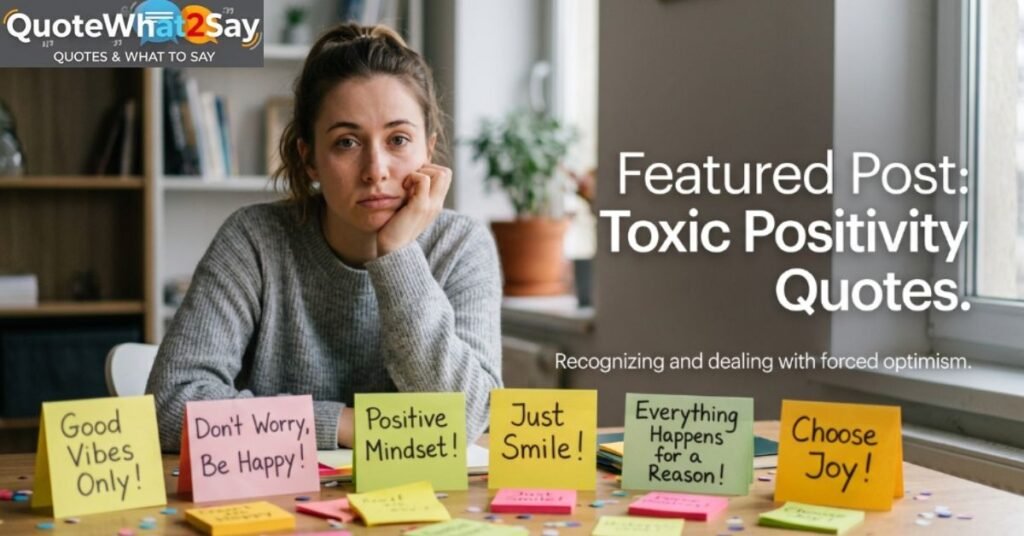
Not all toxicity is cruel — some of it is dressed up as encouragement. Toxic positivity dismisses real pain with forced cheerfulness, and it deserves its own place in this collection of toxic quotes.
- “Just stay positive” is sometimes the fastest way to make someone feel unheard.
- Real support does not require you to skip the hard feeling on the way to the hopeful one.
- Toxic positivity asks you to perform being fine instead of actually becoming fine.
- Not every situation needs a silver lining. Some situations just need to be survived.
- Forcing gratitude onto grief does not heal the grief — it just silences it.
- You are allowed to say “this is genuinely hard” without immediately following it with “but it’s fine.”
- The people who rush your pain toward positivity are usually more uncomfortable with your pain than you are.
- Healthy support sits with the bad feeling first. Toxic positivity skips straight to the bow on top.
Part 9: Cutting Off Toxic People — Quotes for the Hardest Decision

Cutting someone off is rarely the dramatic, clean break it appears from the outside. More often it is a slow, agonizing process of accepting that continuity is more harmful than rupture. These quotes honor the weight of that decision.
- Cutting someone off is not an act of hatred. It is an act of self-preservation that the other person’s behavior made necessary.
- The hardest people to cut off are not the ones who were always cruel — they are the ones who were sometimes wonderful.
- You do not have to hate someone to recognize that their presence in your life is consistently making it worse.
- Ending a relationship with a toxic person is not giving up on them. It is giving up on the version of yourself that keeps absorbing their damage.
- The grief of cutting someone off is real even when the decision is entirely correct. Both things can be true at the same time.
- Sometimes the kindest thing you can do for yourself is to stop trying to fix a dynamic that the other person has no interest in repairing.
- Cutting off someone you love is not an act of indifference. It is the most honest acknowledgment that love alone is not sufficient grounds for continued harm.
- You are allowed to remove people from your life without a dramatic confrontation, without a final speech, and without their understanding or permission.
- Distance is not always distance. Sometimes it is the most loving thing available when the alternative is continued mutual harm.
- The relationship you are mourning when you cut someone off is often the one you wished you had, not the one you actually did.
Part 10: Quotes About Healing After Toxic Relationships
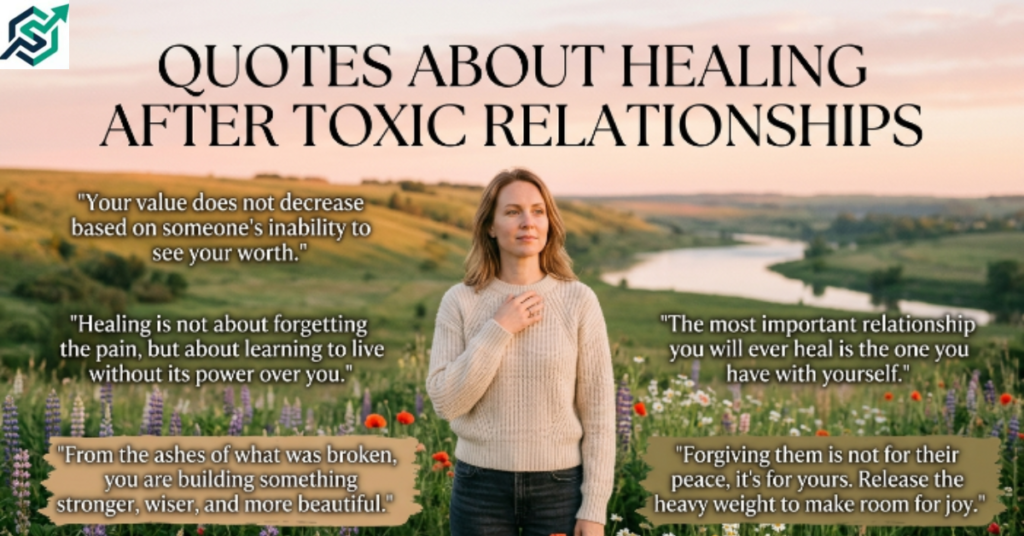
Healing from toxic relationships is its own complex process — different from recovering from grief, different from getting over a breakup, complicated by the self-doubt and identity erosion that toxicity leaves behind. These quotes accompany that process honestly.
- Healing from a toxic relationship means rebuilding a relationship with your own instincts, which the toxicity systematically taught you not to trust.
- The hardest part of recovering from a manipulative relationship is not the anger — it is the long, quiet process of learning to believe your own perceptions again.
- You may find yourself defending someone who hurt you for years after the relationship ends. That is not loyalty — it is the residue of conditioning, and it fades with time and honesty.
- Recovery is not linear. Some weeks you feel free. Some mornings you wake up and the old weight is back. Both are normal parts of the same process.
- The version of you that existed before the toxic relationship is not coming back — and that is not entirely a loss, because who you become after it can be stronger, clearer, and more deeply yourself.
- Healing requires allowing yourself to be angry, not just sad. The anger is not bitterness — it is your sense of justice beginning to function normally again.
- Therapy after a toxic relationship is not weakness. It is the recognition that some damage requires professional tools to repair properly.
- The trust you rebuild in yourself after a toxic relationship is harder-earned and therefore more durable than the trust you had before it.
- Part of healing is forgiving yourself for staying as long as you did — and understanding that the reasons you stayed were not stupidity but humanity.
- You did not fail the relationship. The relationship failed to be what relationships are supposed to be.
Part 11: Deep Toxic People Quotes for the Ones Who Overthink

Some people do not need simple validation — they need complex, layered language that matches the complexity of what they experienced. These deep toxic people quotes are for the analytical ones, the ones who have turned their experience over a thousand times looking for understanding.
- Toxic people are not necessarily bad people. Many of them are deeply wounded people who have not yet taken responsibility for the wounds they create in others.
- The tragedy of toxic dynamics is that they often involve two people who genuinely care about each other and are still systematically harming each other.
- Understanding why someone became toxic does not obligate you to become the site of their continued damage.
- Some people learned harmful patterns so early and so completely that they genuinely cannot see them — and your empathy for that reality is admirable but cannot become your burden to carry.
- The most intellectually honest position on a toxic person is this: they may be doing the best they can, and their best is still causing you harm, and both of those facts can be true.
- Cognitive dissonance in toxic relationships — holding the belief that someone loves you alongside the evidence that their behavior hurts you — is one of the most psychologically exhausting states a person can inhabit.
- Intermittent reinforcement — unpredictable warmth and withdrawal — creates stronger emotional attachments than consistent love. That is the neuroscience behind why toxic relationships are so difficult to leave.
- The person who harms you is not the same as the person you love. Sometimes they inhabit the same body, which is why the leaving is so extraordinarily complicated.
- Empathy without boundaries is not a virtue — it is a vulnerability that certain people will exploit without ever needing to consciously decide to do so.
- The capacity to hold complexity — to understand someone, to love them, and still to choose your own safety — is not contradiction. It is the most mature form of emotional intelligence available.
Part 12: Quotes About Walking Away and Choosing Your Peace

Walking away from toxicity is not the beginning of peace — it is the first step in a much longer journey. But it is the step that makes all the others possible. These walking away quotes honor the courage that the first step requires.
- Walking away from a toxic relationship is not the easy choice. It is the right one. Those are rarely the same thing.
- There is nothing passive about choosing peace. It is one of the most active, courageous, ongoing decisions a person can make.
- Walking away does not require the other person to understand, agree, or validate your decision. It only requires you to make it.
- The version of you that exists after walking away from toxicity is not less for having gone through it — it is more precise, more boundaried, more certain of what it will and will not accept.
- Peace is not the absence of conflict. It is the presence of an environment where conflict does not define the relationship.
- Sometimes walking away is not giving up. It is finally giving yourself what you spent years offering to someone who did not receive it.
- The decision to leave is usually made dozens of times before it is finally made once, and all those previous decisions count — they were practice for the real one.
- You do not need to explain your departure to people who could not understand your pain while you were still standing in it.
- What you walk away from determines what you are able to walk toward.
- Choosing your peace is not selfishness. It is the prerequisite for every good thing you will do for anyone else going forward.
Part 13: Realistic Toxic People Quotes for Instagram and Social Media
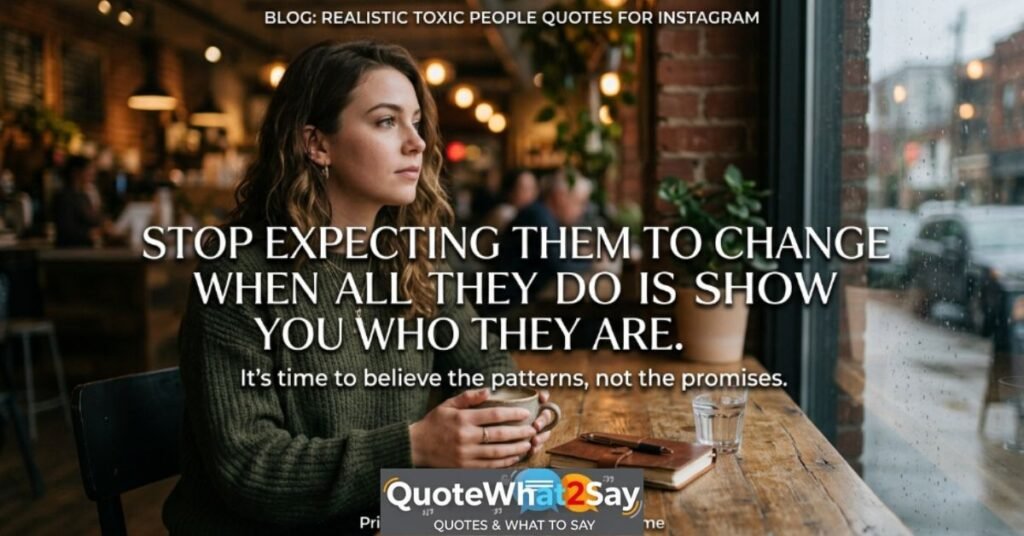
These are quotes crafted for impact in small spaces — sharp enough to stop a scroll, honest enough to create recognition, and real enough to be worth sharing.
- Not everyone who calls you family is safe. Not everyone who calls you friend is loyal. Patterns are the truth; words are the draft.
- The most dangerous person in the room is not the one who shouts. It is the one who smiles while quietly dismantling you.
- Exhausted for no reason is sometimes exhausted for one specific reason that you have been too generous to name.
- Your nervous system knows before your mind admits it. Pay attention to who makes you tense before they have even spoken.
- Healing starts the day you stop needing them to admit what they did.
- Red flags were always visible. You just loved the person wearing them.
- The distance you created was not coldness. It was clarity finally given permission to act.
- You did not lose a good person. You lost the version of them you needed them to be.
- Stop shrinking to fit into spaces that were never built for the real size of you.
- Their discomfort with your boundaries is the loudest endorsement your boundaries have ever received.
- You are not too sensitive. You were surrounded by people insufficiently careful.
- Cutting people off is not a personality flaw. Sometimes it is a survival skill dressed in difficult decisions.
- The relationship that cost you your peace was always too expensive.
- Walking away quietly is still walking away. You do not owe anyone a dramatic exit.
- Trust the exhaustion. It is usually a more accurate diagnosis than anything your mind offers in their defense.
Part 14: Quotes About Protecting Your Energy Like It Is Irreplaceable

Energy — emotional, mental, creative, spiritual — is the currency of a life well-lived. Toxic people understand this intuitively, even if unconsciously, which is why they are so drawn to people who have not yet learned to protect it. These quotes make the case for guarding it fiercely.
- Your attention is not infinite. Your emotional availability is not infinite. Treat both as the finite, precious resources they actually are.
- Every hour you spend managing a toxic dynamic is an hour you are not spending building the life you actually want.
- Energy protection is not rudeness. It is the natural consequence of having learned, sometimes the hard way, that not everyone deserves unlimited access to you.
- The people who drain you the most are often the ones most offended when you begin conserving what they have been taking.
- Choosing who receives your energy is one of the most consequential choices you make — and one of the least consciously examined ones.
- You can be a genuinely caring person and still decline to donate your wellbeing to people who will not reciprocate it.
- Protecting your energy does not require explanation or justification. It requires only the decision, repeated as many times as necessary, to take it seriously.
- The creative work, the relationships, the ambitions you have — all of them depend on energy you cannot afford to continuously surrender to toxic dynamics.
- Peace is not a luxury available only to people without problems. It is a protected environment you deliberately choose to create.
- You are allowed to be generous with some people and protective with others. Discernment is not the same as stinginess.
Once you’ve protected your energy, channel it forward — these 130 Boss Lady / Girl Boss Quotes are built for exactly that next chapter.
Part 15: Final Truths — 250+ Realistic Quotes Worth Reading Twice
These final entries are distilled truths — observations about toxic people, toxic dynamics, and the long road back to yourself that are worth keeping.
- You cannot logic your way out of an emotionally abusive dynamic. Logic is precisely what gets used against you inside it.
- The most sophisticated toxic people are the ones who have convinced themselves they are the victim in every story they have ever told.
- When someone consistently makes you feel crazy for having normal responses to abnormal situations, that is not a relationship dynamic. That is a methodology.
- Your healing does not require their acknowledgment. Waiting for it is another way of staying inside their influence.
- The relationship that almost destroyed you also taught you exactly how strong you are. Both statements are true and neither cancels the other.
- Toxic people rarely change for the people they have already harmed. They sometimes change for the next person, after the cost finally became too high.
- You are not responsible for saving people who are actively using your empathy as raw material for your own destruction.
- The fantasy of who they could be kept you longer than the reality of who they were. That is not naivety. It is love looking for somewhere to land.
- Self-respect, after a toxic relationship, is not a return to who you were. It is the construction of someone who will never accept that treatment again.
- Every person who recognizes a toxic dynamic and chooses to leave it makes the same choice slightly easier for someone else. That is not a small thing.
- Surviving a toxic relationship does not make you damaged. It makes you educated in something most people learn the hardest way.
- The silence after cutting someone off is uncomfortable precisely because it used to be filled with chaos. You will adjust to the quiet. The quiet is safe.
- Toxic people often experience genuine love for you — and that love is still insufficient grounds for the harm they cause. Both can be real.
- Forgiving someone does not require giving them continued access to you. Forgiveness is internal. Access is a separate decision entirely.
- You owe yourself at least the same quality of relationship you have consistently offered to people who did not deserve it.
- The version of you that existed inside that toxic relationship was your survival self — resourceful, adaptive, and exhausted. The version emerging now is your actual self.
- Some relationships end not with a betrayal but with a quiet recognition that staying is a choice you are no longer willing to make.
- The people who say “you’ve changed” after you set boundaries are people who preferred the version of you that had none.
- Healing is not the elimination of the memory. It is the process of the memory losing its power over your present moment.
- Your worth was never determined by someone’s willingness to recognize it.
- Toxic dynamics teach you the precise shape and weight of what you will never again accept. That knowledge is not damage — it is discernment.
- The years you spent inside a toxic relationship were not wasted. They were expensive, but they purchased something real: an intimate understanding of what you deserve and what you do not.
- You are allowed to outgrow people who were once everything to you. Growth is not betrayal. It is biology applied to the emotional self.
- The version of you that finally walked away had been building the courage for that moment for longer than you know.
- You are not too much. You were with people who were not enough — not enough honest, not enough healthy, not enough willing to meet you where you were.
Bonus: 50 Additional Realistic Toxic People Quotes
- Some people need you to stay broken to feel useful. Your healing threatens the role they assigned themselves.
- Accountability is the one thing a toxic person will consistently find a way to avoid.
- The relationship where you were most yourself is the one you need to find your way back to — and it will not be with them.
- Consistency in kindness is rare. Consistency in harm is a pattern worth naming.
- You were not imagining it. You were documenting it with your body and your memory and your gut, and all three were correct.
- When someone apologizes for the exact same thing eleven times without changing the behavior, the apology has become part of the pattern.
- The exhaustion of explaining yourself to someone who has already decided the narrative is one of the most demoralizing experiences in human relationships.
- Toxic people rarely believe they are toxic. They believe they are the reasonable one in a world full of people who cannot handle them.
- Your nervous system is a more accurate compass than your hopefulness. Both deserve consideration, but in different proportions.
- People who genuinely love you do not require you to contort yourself into manageable shapes.
- The moment you stop performing peace you do not feel, the relationship will either become honest or it will end. Both are acceptable outcomes.
- Being too understanding for too long in the wrong relationships is how excellent people end up deeply depleted.
- When someone makes you feel guilty for enforcing your own limits, they are outsourcing their discomfort to you. You can decline to receive it.
- Some of the most harmful relationships never involve a single raised voice — just a consistent, quiet erosion of your certainty about yourself.
- You were not too trusting. You were trusting the right amount. They were simply unworthy of it.
- The cruelest thing about toxic relationships is that they do not just hurt you in the present — they teach you to hurt yourself in the future, in their absence.
- Self-doubt that arose specifically inside one relationship and disappeared when that relationship ended is not self-doubt. It is the residue of that relationship.
- You cannot negotiate with someone whose primary goal in the negotiation is to make you feel wrong for negotiating.
- Toxic people are extraordinarily skilled at making their comfort your responsibility without ever formally assigning you the role.
- The grief of leaving is real. So is the grief of staying. You get to choose which grief leads somewhere better.
- Distance from certain people is not coldness — it is temperature regulation for your own survival.
- When you stop participating in the chaos someone creates, they will initially escalate before eventually finding a different audience.
- You cannot heal inside the environment that caused the wound. At some point, physical or emotional distance becomes medical necessity.
- People who demand loyalty from you while practicing inconsistency toward you have a definition of loyalty that only runs in one direction.
- The day you realize you have been apologizing for things that were not your fault is the day your recovery begins in earnest.
- There is a particular freedom in understanding that you cannot love someone into becoming safe.
- Being deeply good at managing toxic people is not a superpower — it is evidence of a difficult education you did not choose.
- Your capacity for patience and forgiveness is extraordinary. The tragedy is not that you have it — it is where you kept directing it.
- Toxic relationships do not just end — they leave forwarding addresses in your body, your habits, and your future relationships. Therapy is how you update those addresses.
- Peace that had to be earned inside a relationship was never peace. It was a ceasefire with a timer.
- The most honest thing you can do after a toxic relationship is refuse to minimize what happened in order to make anyone — including yourself — more comfortable.
- You gave them the benefit of the doubt until there was no doubt left to give the benefit of.
- Healing does not always look like peace. Sometimes it looks like anger, and the anger is appropriate, and the anger is part of the process.
- The best revenge for a toxic relationship is not making them pay. It is becoming so fully yourself that you no longer think about them in those terms.
- You are not the sum of how they treated you. You are what you do with the self that survived it.
- Some wounds close only from the inside — and only after you have stopped reopening them by returning to the thing that caused them.
- The clarity that comes after a toxic relationship ends is so sharp it sometimes hurts. That is your instincts waking back up after a long, enforced silence.
- You do not have to announce your healing to the person who made it necessary.
- The people who made you feel the least like yourself were teaching you, in the most uncomfortable way available, exactly what yourself actually is.
- Learning to trust your own perception again after gaslighting is slow work, and it is the most important work you will do.
- Not every chapter of your life was meant to end well. Some chapters were meant to end, and the ending itself was the lesson.
- You stayed because you are the kind of person who does not give up on people. You left because you are the kind of person who eventually refuses to give up on yourself.
- The instinct you overrode in the beginning of that relationship — the small, quiet discomfort — was correct. You were not wrong to feel it.
- Letting someone go is not failure. It is the recognition that holding on had become the only thing keeping both of you from growing.
- Toxic people will remember the relationship very differently than you do. Your version is not wrong simply because it differs from theirs.
- You do not need closure from them. You need closure within yourself, and that is something only you can give.
- The most important relationship you will rebuild after a toxic one is not your next romance or friendship — it is your relationship with your own judgment.
- Surviving something does not mean you are fine. It means you survived. Fine comes later, with work, with time, and with honest support.
- Every healthy relationship you build from here is evidence that what happened to you did not define what you are capable of.
- You were never the problem. You were the person the problem happened to. There is a profound difference, and you deserve to feel it.
Why These Toxic People Quotes Hit Differently

Most quote collections give you five-word lines designed to fit a phone screen. This collection was built around a different belief: that people who have lived through genuinely harmful relationships deserve language that matches the complexity of what they experienced.
The experience of toxic relationships involves sophisticated psychological dynamics — intermittent reinforcement, cognitive dissonance, trauma bonding, identity erosion — that five-word quotes cannot adequately name. Research in attachment theory and trauma psychology consistently shows that naming an experience accurately is among the first steps in processing and recovering from it.
When you read a quote and feel that is exactly it — that recognition is therapeutic in a real, documented sense. It is called normalization, and it functions by breaking the isolation that toxic dynamics deliberately cultivate. You stop feeling crazy. You start feeling witnessed. And from witnessed, the road to healed becomes slightly more navigable.
Recognizing Toxic Behavior Patterns — A Quick Reference
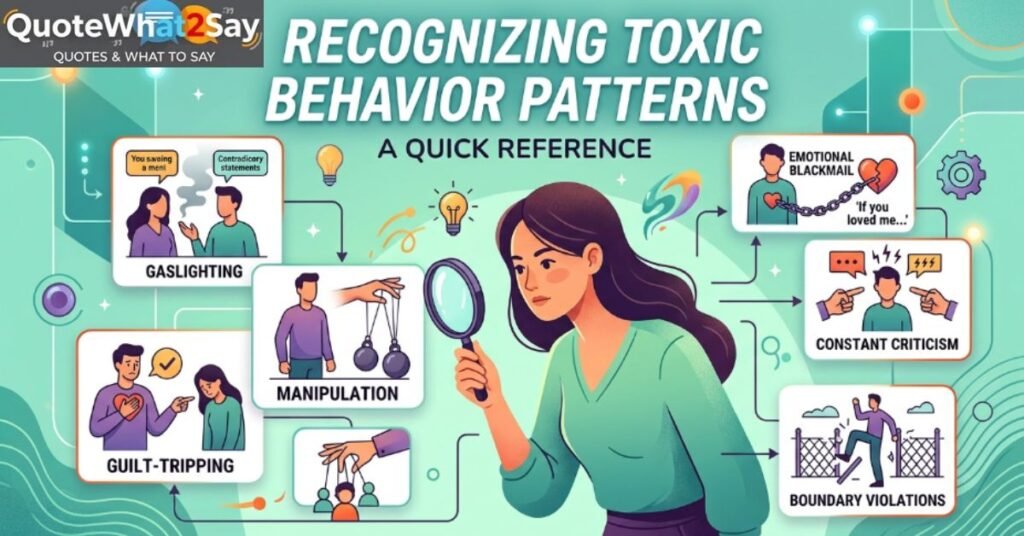
Toxic behavior presents in recognizable patterns. Here are the most commonly documented dynamics, named clearly:
Gaslighting — Causing you to doubt your own memory, perception, or sanity by consistently denying, reframing, or minimizing your experience.
Love Bombing — Overwhelming affection and attention early in a relationship, used to create rapid attachment before the controlling or harmful behavior begins.
DARVO — Deny, Attack, Reverse Victim and Offender. A response pattern where the harmful person denies responsibility, attacks the person raising concerns, and reframes themselves as the real victim.
Intermittent Reinforcement — Unpredictable cycles of warmth and withdrawal that create powerful emotional attachment, stronger in many cases than consistent love would produce.
Triangulation — Introducing a third party — real or implied — to create jealousy, insecurity, or competition as a control mechanism.
Emotional Dumping — Using another person as a repository for emotional processing without consent, reciprocity, or acknowledgment of the cost to the other person.
Recognizing these patterns in language you have already lived is not about assigning clinical diagnoses. It is about giving accurate names to experiences that previously felt impossible to articulate.
Signs You’re Dealing With a Toxic Person
Before the quotes go any deeper, it helps to name what toxic actually looks like in daily life. These are the patterns people most consistently report:
- You feel worse, smaller, or more anxious after most interactions with them.
- You rehearse conversations in advance to avoid a reaction.
- Apologies flow only one direction — from you to them.
- Your good news is met with silence, competition, or a redirect.
- They deny things you clearly remember happening.
- Boundaries are treated as personal attacks.
- You feel responsible for managing their moods.
- Friends or family have gently raised concerns about the relationship.
If several of these feel familiar, the toxic quotes above are not exaggerating your experience — they are describing it accurately.
How to Use This Collection
These quotes are tools, not passive entertainment. Here are specific ways to use them intentionally:
For Processing: Read slowly, particularly through sections that resonate most. Notice which quotes produce the strongest recognition. Journal about what specifically they illuminate.
For Sharing: Forward specific quotes to people you trust who are currently inside difficult dynamics. Sometimes the right words, received from the right person at the right moment, create the first crack in a very long denial.
For Therapy: Bring quotes that particularly resonated to sessions. “This said exactly what I couldn’t articulate” is a powerful starting point for therapeutic work.
For Social Media: The Instagram section was built for this — but any quote here is appropriate to share when it genuinely reflects your experience rather than simply performing your healing.
For the Hardest Days: Return here on the days when the doubt returns, when you wonder whether you overreacted, whether you were too sensitive, whether you were the real problem. Read until you remember that you were not.
Conclusion
Toxic people are not always monsters. That would be simpler, and simplicity would make the leaving easier. Instead, they are often people you loved, people who loved you in the only way available to them, people whose damage and your damage met and combined into something neither of you could sustain.
These 250+ realistic toxic people quotes were written to accompany every stage of that experience — the recognition, the confusion, the grief, the anger, the decision, the leaving, the healing, and the long, nonlinear process of becoming yourself again after someone else spent considerable time convincing you that your self was the problem.
It was not. You were never the problem. You were the person standing in a situation that required more than love to survive — it required clarity, and the courage to act on it, and the patience to heal from it, and the wisdom to eventually recognize what you will and will not accept going forward.
That version of you — the one reading this — has already come further than you know.
FAQs
What makes these toxic people quotes different from others?
Most toxic people quote collections use very short, five-word lines designed for quick social sharing. This collection was built around full, detailed observations that match the psychological complexity of what people actually experience inside toxic dynamics. Each quote is long enough to carry genuine meaning.
Are toxic people always aware that they are toxic?
Not always. Research in psychology suggests that many people with harmful behavioral patterns are not consciously aware of them, particularly when those patterns developed as coping mechanisms in difficult early environments. This does not excuse the harm caused — but it does complicate the narrative of the deliberate villain, which is why many of these quotes hold that nuance.
How do I know if I am in a toxic relationship?
Some consistent indicators include: feeling consistently worse about yourself after time spent with them, excessive rehearsing of conversations to manage their reactions, a pattern of apologizing for things that were not your fault, the sense that their emotional state is always your responsibility, and a specific fatigue that rest does not resolve. If multiple descriptions in this article produced strong recognition, that recognition is meaningful.
Is it possible to maintain a relationship with a toxic person?
In some contexts — particularly with family members or co-parents where complete distance is not practical — managed contact with firm boundaries is possible. The key variables are whether the person is genuinely working to change their patterns, whether your boundaries are consistently respected, and whether your emotional and mental wellbeing is sustainable within the arrangement.
How long does healing from a toxic relationship take?
Recovery timelines vary enormously based on the duration and intensity of the relationship, the specific dynamics involved, individual resilience factors, and access to support. What is consistent across research is that working with a qualified therapist significantly accelerates the process, particularly for relationships involving gaslighting or emotional abuse, where the damage to self-trust runs deepest.
What’s the difference between toxic quotes and toxic people quotes?
Toxic quotes is the broader term — it covers toxic relationships, toxic friendships, toxic workplaces, and toxic family dynamics. Toxic people quotes narrow the focus specifically to the individuals causing the harm. This collection includes both.
Can reading toxic quotes actually help you recognize toxic behavior?
Yes. Naming a pattern accurately — through toxic quotes, journaling, or therapy — is one of the first documented steps in recognizing and eventually leaving a harmful dynamic. Recognition often comes before language does, and the right quote can supply that missing language.

I’m Grace Morgan, a professional content writer with 3+ years of experience and AI content writing expertise, creating clear, engaging, and easy-to-understand content for readers.
