

If you searched for fundfireinsight.com expecting an institutional-grade finance tool, you are not the only one. The name sounds like something built for hedge funds, mandate tracking, or professional portfolio software. But what you actually land on is very different from what the name suggests.
This review breaks down exactly what fundfireinsight.com is, what it is not, and how much trust you should place in the content it publishes. We will look at its structure, its technical setup, and how it compares to genuinely verified financial sources.
Many readers land on this site through a search engine result, expecting something tied to Wall Street level data. Understanding the gap between expectation and reality is the whole point of this review, and it matters more than most people realize before making financial decisions based on what they read online.
see also: PlusStories.com Review 2026: What Is PlusStories and How Does It Work?
What Is fundfireinsight.com? (Institutional Tool vs Finance Blog)
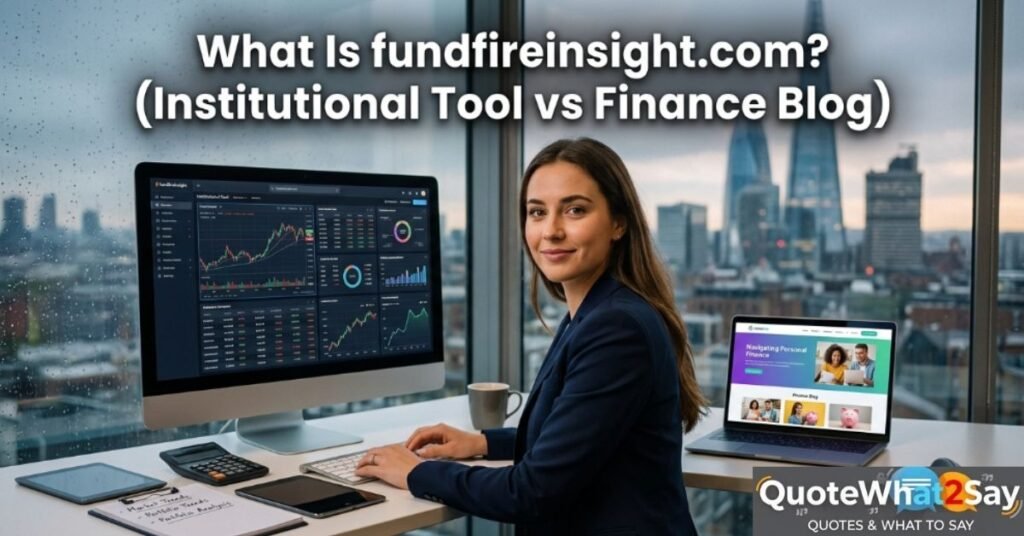
At a basic level, fundfireinsight.com is a general finance blog. It publishes articles about banking, credit cards, e-commerce payment strategies, and everyday investment topics.
It is not a portfolio management platform, not an institutional data terminal, and not connected to any licensed financial advisory service. The site simply produces written content aimed at casual readers browsing for money-related information.
This distinction matters because the finance space online is full of websites that sound bigger than they actually are. A confident name and professional-looking layout do not automatically mean institutional-grade credibility sits behind them.
Finance Content and Financial Authority Are Different Things
Publishing articles about finance does not automatically make a website a financial authority. Authority usually comes from licensing, regulatory recognition, verified credentials, or long-standing institutional trust.
A blog can write clearly and helpfully about money topics while still having no official standing in the finance industry. Readers need to separate “writes about finance” from “is a recognized financial authority.”
This gap is not unique to this one site. It applies broadly across the internet, where thousands of blogs cover finance topics without any formal regulatory backing. Recognizing this pattern helps readers approach any similar site with the right level of caution.
FundFireInsight.com at a Glance
Here is a simple table summarizing the site’s basic profile before we go deeper.
| Category | What It Actually Is |
| Site Type | General finance and lifestyle blog |
| Main Topics | Banking, credit cards, investing basics, e-commerce finance |
| Institutional Tools | None found |
| Regulatory Status | No visible licensing or regulatory affiliation |
| Revenue Model | Appears ad-supported |
| Best Used For | Beginner-level reading and topic discovery |
This table gives a fast snapshot, but each row deserves a closer look, which is exactly what the rest of this review walks through step by step.
Deconstructing the “Institutional Mandate Software” Misconception
A lot of confusion around this site comes from its name alone, not its actual content.
1. The Institutional Dashboard & Mandate Analytics Myth
Some readers assume a site with “fund” and “insight” in its name must offer dashboards, mandate tracking, or fund manager analytics. This is simply not the case here.
There is no login portal for institutional data, no live trading terminal, and no mandate-tracking software anywhere on the site. It functions purely as a content publisher.
This misconception often comes from years of exposure to actual institutional platforms that use similar naming conventions. Readers carry that expectation over without realizing the two categories of website serve completely different purposes.
2. Domain Network Variants & Search Query Manipulation
Search results for this name often surface several similar-looking domains, including variations with slightly different spellings or extensions.
These mirror-style domains can confuse readers trying to find the “real” version of the site. It is worth double-checking the exact spelling and extension before trusting any link you click.
This pattern is common across many growing content niches, where multiple sites publish similar material under closely related names to capture overlapping search traffic. It is not always a sign of bad intent, but it does require extra attention from the reader.
Three Things That Should Not Be Confused
To understand this site properly, it helps to separate three different layers.
1. The Domain
The domain itself is just a web address. It does not carry any built-in authority, license, or guarantee of accuracy on its own.
Anyone can register a domain with confident, professional-sounding words in it. The words in a web address say nothing about who owns the site or how accurate its content actually is.
2. The Site’s Positioning
How a site describes itself in its own marketing language is separate from what it factually offers. A site can describe itself using confident, professional-sounding language while still functioning as a basic content blog underneath.
Marketing copy is written to attract clicks and build trust quickly. It should never be treated as a factual audit of what a platform actually delivers.
3. The Individual Article
Even on a general blog, some individual articles may be well-researched, while others may be thin or generic. Judge each article on its own, not just based on the site’s overall branding.
This means a reader should evaluate quality one article at a time rather than assuming every single post carries the same level of depth or accuracy.
What FundFireInsight.com Actually Publishes
Based on available content, the site focuses on topics that are common across many general finance blogs.
- Beginner-friendly investment explainers
- Credit card comparison and review-style posts
- Banking product overviews
- E-commerce and online payment strategy content
- General personal finance tips
- Occasional business and market trend commentary
What the Content Mix Tells a Reader
This mix suggests the site is built for broad search traffic rather than a specific professional audience. The topics are common, widely searched terms rather than specialized institutional subjects.
This is a normal and common structure for ad-supported content sites, not necessarily a red flag on its own, but it does tell you what kind of source you are dealing with.
A reader looking for specialized, deeply technical institutional analysis is unlikely to find that depth here. A reader looking for a simple, easy-to-follow explanation of a common finance topic is more likely to find something useful.
Domain Extensions & Mirror Network Confusion
Because the core name is short and catchy, multiple similar domains and extensions have appeared using nearly identical branding.
| Pattern | What to Watch For |
| Slightly different spelling | Extra words or letters added to the base name |
| Different extension | Same name but ending in .net, .org, or similar instead of .com |
| Mirrored content | Identical or very similar articles republished across multiple domains |
| Rebranded layout | Same core content presented with a different site design |
None of these variants are automatically dangerous, but they do make it harder for readers to know which version they are actually reading.
This kind of domain sprawl is increasingly common in fast-growing content niches. When a name performs well in search results, similar domains often appear quickly, sometimes from the same publisher and sometimes from unrelated third parties trying to capture leftover traffic.
see also: What to Say in a Farewell Speech For Teacher Leaving the School (15 Examples)
FundFireInsight.com and FundFire

This is one of the most important distinctions in this entire review. FundFire is a long-established institutional finance news service, historically associated with Financial Times style asset management coverage aimed at fund managers and institutional investors.
FundFireInsight.com is a completely separate entity with a similar-sounding name. There is no confirmed institutional or corporate relationship between the two based on available information.
This kind of naming overlap happens more often than most readers expect. A newer site can end up sounding almost identical to an established, respected name purely by coincidence or by intentional design to borrow some of that recognition.
The Practical Distinction
FundFire style institutional publications are typically subscription-based, professionally staffed, and used by industry insiders for serious decision-making. FundFireInsight.com, by comparison, functions as an open, ad-supported blog aimed at general readers.
Confusing the two could lead someone to treat casual blog content with the same weight as institutional-grade reporting, which would be a mistake.
The practical takeaway is simple: always check which specific organization you are actually reading before assuming a certain level of professional rigor stands behind the content.
Claim vs Reality Breakdown
| Claim Readers Might Assume | Actual Reality |
| Institutional mandate tracking tool | Simple content blog |
| Connected to major finance news wires | No confirmed connection |
| Real-time trading data | Not present |
| Licensed financial advisory | No visible licensing |
| Professional analyst team | Not verifiable from public site information |
| Regulatory oversight | No regulatory affiliation shown |
This side-by-side comparison makes the gap between expectation and reality easy to see at a glance, which is exactly the kind of confusion this review aims to clear up.
What Kind of Source Is a FundFireInsight.com Article?
Not every source serves the same purpose. Here is how to categorize this type of content correctly.
Discovery Source
It can work well as a starting point to discover a topic you know little about, like a basic explanation of a financial term or product category.
Discovery-stage reading is low-risk, since the goal is simply to become aware that a topic exists before researching it more seriously elsewhere.
Explanation Source
For simple explanations written in plain language, this type of blog can be genuinely useful, especially for beginners.
Plain-language explanations help readers build a basic vocabulary around finance topics before moving on to more technical or official material.
Commentary Source
Some articles may include opinion-style commentary on trends, which should be read as one perspective rather than confirmed fact.
Commentary can still add value by highlighting angles a reader might not have considered, as long as it is clearly understood as opinion rather than verified data.
Evidence Source
This is where caution matters most. Content from a general blog should not be treated as verified evidence for major financial decisions without independent confirmation.
Treating blog commentary as hard evidence is one of the most common mistakes casual readers make online, and it applies just as much here as it does to any similar general content site.
How Much Weight Should You Give a FundFireInsight.com Article?

Before trusting any single article, check these basic factors.
Author
Look for a named author with visible credentials. Anonymous or unclear authorship should lower your confidence level.
A named author with a clear background gives you something to verify. Anonymous content leaves you with no way to judge expertise behind the writing.
Date
Financial information changes quickly. Always check whether the article reflects current information or outdated numbers.
An article written even a year or two ago may reference rates, products, or figures that have since changed significantly.
Sources
Strong articles link back to primary data or official sources. Articles with no visible sourcing deserve extra scrutiny.
If a claim sounds specific, like a statistic or percentage, check whether it links back to where that number actually came from.
Commercial Context
Ad-supported blogs sometimes have financial incentives tied to certain product recommendations. Keep this in mind when reading comparison-style content.
Recommendations tied to affiliate links or sponsored placements are not automatically wrong, but they should be read with that context in mind.
Technical Infrastructure & Security Audit
A basic technical review helps readers understand what they are actually browsing.
Domain Registration & WHOIS Privacy Status
Like many content sites today, ownership details may be shielded through standard domain privacy services. This is common practice across the web and is not automatically suspicious on its own, though it does mean readers cannot easily verify who runs the site.
Domain privacy is used by countless legitimate small businesses and blogs, so its presence alone should not be treated as a warning sign, only as a limit on how much ownership verification is possible.
SSL Encryption & Security Verification
Standard websites in this category typically use basic SSL encryption for the connection between browser and server, shown by the padlock icon in most browsers. This protects the connection itself but does not verify the accuracy of the content published.
A secure connection only confirms that data traveling between your browser and the site is encrypted. It says nothing about whether the information on the page is correct or complete.
Financial Hygiene & Ad-Network Exposure
Ad-supported blogs often display third-party advertising, which can include financial product promotions. Readers should treat these as advertisements first, not neutral recommendations.
It also helps to be cautious of any ad that pushes urgency, like limited-time financial offers, since this is a common pattern across many ad-supported content sites, not unique to this one.
Why the Exact URL Matters

With several similar domain names circulating, small details in the web address matter a lot.
Domain Check
Before trusting any page, check the exact spelling, the extension, and whether the design matches what you expect from previous visits. If something feels off, it is worth double-checking through a fresh search rather than clicking a saved or shared link blindly.
A quick habit worth building is typing the domain manually into your browser rather than always clicking links from search results or shared messages, especially when dealing with anything finance related.
Is fundfireinsight.com Safe to Browse?
Based on available information, the site appears to function as a standard content blog rather than anything designed to steal information directly. Standard browsing precautions still apply, such as avoiding entering sensitive financial account details anywhere on a general content site.
As with any ad-supported blog, expect display advertising and sponsored content mixed in with regular articles.
General safety habits, like keeping your browser updated and avoiding entering banking credentials on any content-only website, apply here just as they would on any similar site across the internet.
How to Use FundFireInsight.com
If you choose to use this site, here is a simple way to approach it.
Discovery
Use it to find topics worth researching further, especially if you are new to a financial concept.
Orientation
Use it to get a basic, plain-language overview before diving into more technical sources.
Comparison
Use it as one opinion among several when comparing financial products, not the only source.
Verification
Always verify any specific numbers, rates, or claims through official or regulated sources before making financial decisions.
Following this simple four-step approach keeps the site useful without letting it become the only voice shaping a real financial decision.
FundFireInsight.com: Facts, Observations, and Inferences

It helps to separate what is confirmed from what is simply likely based on available information.
- Fact: The site publishes general finance and lifestyle content
- Fact: No institutional trading tools are visible on the platform
- Observation: Several similarly named domains exist in search results
- Observation: Content style matches common ad-supported blog formats
- Inference: The site appears designed primarily for search traffic and ad revenue
- Inference: The naming choice likely benefits from association with more established institutional terms
Understanding the Platform’s Core Mission
Based on its content and structure, the platform’s core mission appears to be providing accessible, beginner-friendly financial information rather than serving professional institutional users.
This is a legitimate and common purpose for a blog, but it is very different from the institutional image the name might suggest to a first-time visitor.
Many successful content sites exist purely to simplify complex topics for everyday readers, and there is nothing inherently wrong with that goal as long as readers understand exactly what they are getting.
Pros & Cons of fundfireinsight.com
| Pros | Cons |
| Simple, accessible language for beginners | Name causes confusion with institutional services |
| Covers common, relevant everyday finance topics | No visible licensing or regulatory credentials |
| Free to access without a subscription | Similar mirror domains create navigation confusion |
| Useful as a starting point for research | Not suitable as a sole source for major decisions |
| Easy to read on mobile and desktop | Commercial ad content mixed into articles |
Verified Alternatives for Institutional Finance & Authentic Advice
If you need genuinely verified information, consider these categories of sources instead.
Accredited Institutional & Asset Management Portals
Look for established, licensed institutional news services with clear regulatory recognition and named professional staff.
These sources typically require subscriptions or professional credentials to access, which reflects the more specialized nature of their audience and content.
Verified Personal Finance & Business Outlets
For everyday personal finance, look for outlets with transparent editorial policies, named financial experts, and clear correction or fact-checking practices.
A visible editorial standards page, clear author bios, and a track record of corrections are all good signs of a more accountable publication.
The Reader’s Decision Framework

Use this simple framework to decide when this type of site fits your needs.
Use FundFireInsight.com For
- Getting a basic introduction to unfamiliar financial terms
- Comparing general product categories at a surface level
- Quick, casual reading on everyday money topics
- Finding search terms worth researching in more depth elsewhere
Verify Elsewhere For
- Any decision involving significant money amounts
- Specific rates, fees, or numbers used for real financial planning
- Anything requiring regulatory or licensed professional confirmation
- Long-term investment strategy decisions
see also: 99 Karma Quotes about Cheating and Betrayal in Relationships and Love
Final Verdict
Fundfireinsight.com is a general, ad-supported finance blog, not an institutional analytics tool or licensed advisory platform. Its name creates understandable confusion with more established institutional services, but the actual content behind it is aimed at everyday readers looking for simple explanations.
Used correctly, as a starting point rather than a final authority, it can be a reasonably useful resource. For any serious financial decision, always cross-check information through verified, regulated, or clearly credentialed sources first.
The bigger lesson from this review applies far beyond just one website. A confident name and professional layout are never a substitute for checking licensing, sourcing, and authorship before trusting any financial content online.
FAQs
Is fundfireinsight.com an official institutional finance platform?
No, it functions as a general, ad-supported finance blog rather than an official institutional or regulated platform.
Does fundfireinsight.com offer real-time trading tools?
No, there are no visible real-time trading terminals or institutional dashboards on the site.
Is fundfireinsight.com connected to FundFire?
There is no confirmed connection between fundfireinsight.com and the established institutional publication FundFire.
Is fundfireinsight.com safe to visit?
It appears to function as a standard content blog, though users should avoid entering sensitive financial details on any general content site.
Why do similar domain names to fundfireinsight.com exist?
Several mirror-style domains with similar names exist, likely to capture search traffic, so always check the exact URL before trusting a page.
Can I trust fundfireinsight.com for major investment decisions?
It is better used as a starting point, with all major decisions verified through licensed or regulated financial sources.
Does fundfireinsight.com have a professional analyst team?
This cannot be confirmed from publicly available site information, so treat authorship claims with caution.
What topics does fundfireinsight.com usually cover?
It typically covers banking, credit cards, e-commerce payment strategies, and beginner-level investment topics.
Is fundfireinsight.com regulated by a financial authority?
No visible regulatory licensing or affiliation is shown on the site based on available information.
What is the best way to use fundfireinsight.com?
Use it for basic topic discovery and simple explanations, then verify any specific numbers or claims through official sources.

I’m Grace Morgan, a professional content writer with 3+ years of experience and AI content writing expertise, creating clear, engaging, and easy-to-understand content for readers.
