

There is a specific kind of sadness that arrives not from loss, but from revelation. It is the sadness of realizing that someone you opened yourself to was never fully present in the way you believed. That the friendship you valued was weighted differently on their side. That the loyalty you assumed was mutual had actually been one-directional for longer than you care to calculate.
Fake people do not usually announce themselves. They arrive in the language of warmth, in small consistent gestures, in the shared history that makes trust feel earned. And then, quietly or suddenly, the evidence accumulates. A moment of crisis that reveals who does not show up. A success that receives a muted response from someone who should have celebrated loudest. A secret that travels further than you gave it permission to go.
The grief of this — the specific grief of a relationship that turned out to be less real than you believed — deserves language proportional to its weight. Not five-word captions. Not recycled lines designed to fit a phone screen. Real sentences that reach the specific places the betrayal actually touched.
This collection of 250+ sad fake people quotes was built for that purpose. Each section addresses a different dimension of the experience — from the first quiet suspicion, through the painful recognition, the anger, the grief, the boundary-setting, and ultimately the growth that only people who have been genuinely disappointed can access. You will find yourself here. That recognition is the beginning of something better.
The Quiet Realization — Quotes for When You First Start to See It

Before the confrontation, before the anger, before the grief — there is a quieter moment. A feeling you cannot fully name. A slight shift in the texture of the relationship that your instincts register before your mind is ready to accept it. These quotes live in that specific, unsettling space between suspicion and certainty.
- There is a particular discomfort in knowing something about a person that you are not yet ready to admit you know.
- The realization does not always arrive loudly. Sometimes it comes as a recurring, quiet discomfort you keep finding reasons to explain away.
- You noticed the first inconsistency long before you allowed yourself to call it what it was. Your generosity was not foolishness — it was loyalty before it was warranted.
- The moment you stop being surprised by someone’s behavior is the moment you have already accepted the truth your mind was still negotiating.
- Fake people rarely trigger one dramatic revelation. They trigger a slow accumulation of small moments that eventually becomes impossible to dismiss.
- The gut feeling that something was off was correct the first time. Every subsequent rationalization was your kindness working against your instincts.
- When you find yourself rehearsing how to bring something up with someone who is supposed to be safe, the relationship has already revealed something important.
- There is a stage before the anger where everything just feels heavy and confusing — where you keep hoping the next interaction will disprove the pattern. It rarely does.
- The saddest thing about recognizing fake people is not the recognition itself — it is counting backward to the moment it started and realizing how much of your authentic self you invested before you saw it.
- You gave them the benefit of the doubt because that is who you are. The problem was never your generosity — it was their consistent failure to deserve it.
- Waking up to fakeness in a relationship feels like adjusting to a change in light — at first disorienting, eventually revealing things you could not see clearly before.
- Some people feel different in retrospect than they felt in the moment. That gap between then and now is not a failure of your perception — it is evidence of their performance.
- The first sign was usually something small. A response that felt slightly off. A moment of enthusiasm that seemed directed at the wrong thing. Instinct files these things long before logic arrives.
- When someone is fake, exhaustion precedes understanding. You feel tired before you know why, because your nervous system processes deception before your conscious mind catches up.
- The quiet realization is painful specifically because it requires you to grieve something while it is still technically present — to mourn a relationship that has not yet ended but has already, in the ways that matter, already ended.
Sad Fake Friends Quotes That Describe the Specific Ache of Betrayal
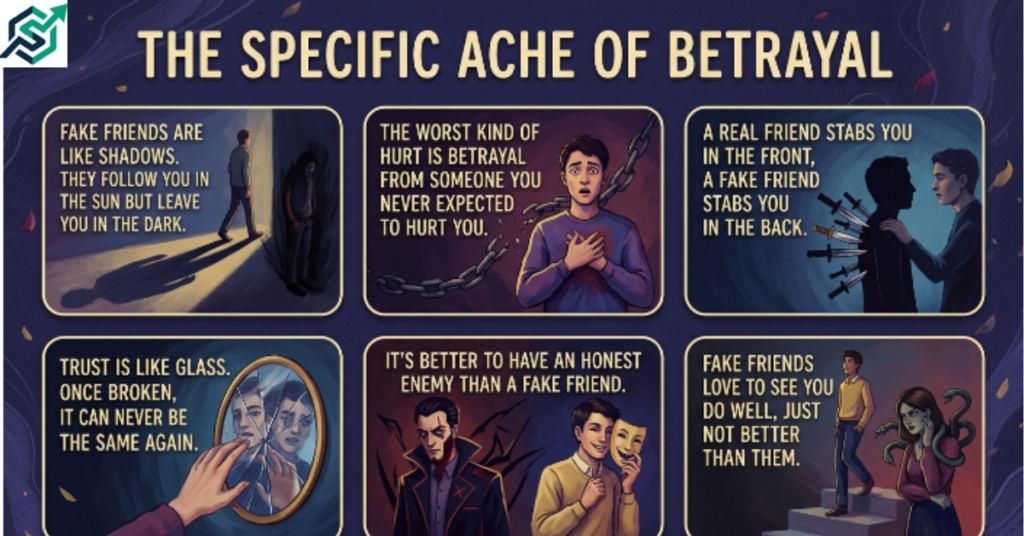
Friendship betrayal occupies a category of pain that is surprisingly difficult to discuss openly. There is no formal language for the ending of a friendship. No social script for the grief of discovering that someone you called a best friend was performing a version of care that served their own needs more than yours. These quotes name that grief without minimizing it.
- A fake friend does not just take the friendship — they take your certainty that the friendship was ever what you believed it to be.
- The cruelest thing about a fake friend is the rewriting it forces — looking back through years of shared history and wondering which parts were genuine and which parts were strategic.
- Fake friends are most painful not when they are absent in crisis, but when you realize their absence in your worst moments was consistent with a pattern you had been choosing not to see.
- There is a specific loneliness in discovering that the person you called first was recording everything you said for an audience you did not know you had.
- The friendship that looked loyal from the outside but felt hollow from the inside — that gap between the appearance and the experience is where fake friendships live.
- You miss the person you thought they were more than the person they actually were. That distinction matters, because what you are grieving is a relationship that never fully existed outside your good faith.
- The friends who disappear during your hardest season were never providing friendship — they were providing company during your comfortable ones. Those are not the same thing.
- Fake friendship is a particular kind of loneliness because it is the kind you experience while technically not being alone.
- The worst fake friends are not the ones who were always cold — they are the ones who were warm enough, often enough, to keep the doubt alive for years.
- Being outgrown by a fake friend is not the same as being left behind by a real one. One involves loss. The other involves revelation. The grief is similar; the meaning is entirely different.
- When a fake friend moves on to someone else with the same warmth they once directed at you, it does not mean the warmth was meaningless — it means it was not personal, which is somehow worse.
- The friend who was your biggest supporter publicly and your quietest underminer privately — that specific combination is the most destabilizing form of betrayal.
- Discovering a fake friend does not just hurt the present relationship — it temporarily contaminates your memory of everything good you shared, and sorting out what was real from what was performance is its own form of emotional labor.
- Some fake friends never do anything overtly terrible. They simply fail, consistently and quietly, at every moment where genuine friendship would have required something real from them.
- The sadness of a fake friend is not just about them. It is about all the authentic, unguarded versions of yourself you shared with someone who was not matching your vulnerability with their own.
Quotes About Two-Faced People and Hidden Agendas
Two-faced behavior is a specific injury because it requires a kind of sustained effort. The person delivering it is not acting on impulse — they are maintaining a performance. These quotes expose the mechanisms behind that performance without softening what it costs the people it is directed toward.
- Two-faced people are not confused about who they are. They have simply decided that the version they show you serves a purpose the authentic version would not.
- The exhausting thing about two-faced people is not the discovery — it is the retroactive understanding of every conversation you assumed was honest.
- When someone speaks differently about you to different audiences, they are not being diplomatic — they are managing their image at the expense of your dignity.
- Two-faced behavior requires a particular kind of discipline that single-faced people underestimate. It is not carelessness — it is a deliberate system.
- The most sophisticated two-faced people never lie outright. They use selective truth, strategic omission, and perfectly timed silence to create the impressions they need.
- Being treated warmly to your face and differently behind your back is not a personality quirk. It is a choice, made consistently, about how much respect you are actually owed.
- The two-faced person’s greatest fear is not being caught lying — it is being forced into a situation where both faces are present at the same time and the inconsistency becomes visible.
- When you discover someone has been speaking about you in ways that contradict how they speak to you, the betrayal is not just in the content — it is in the sustained performance they maintained every time they smiled at you.
- Two-faced people often genuinely believe they are being social rather than deceptive. That self-story does not change the impact, but it does explain why they are always so surprised when called out.
- Hidden agendas are not always sinister in origin — sometimes they are the accumulated small selfishnesses of a person who learned early that honesty rarely gets them what performance does.
- The two-faced person in your life did not become two-faced because of you. But you became the context in which their already-established pattern expressed itself most harmfully.
- Recognizing a hidden agenda requires paying attention to the gap between what someone says they want for you and what their actions consistently produce in your life.
- Some people carry agendas so deeply embedded they have stopped noticing them. Their manipulation is not calculated in the conscious sense — it is simply how their relational operating system functions.
- Two-faced people are often charming. Charm and two-facedness are not opposites — charm is frequently the mechanism through which two-facedness is most effectively sustained.
- The relief of finally seeing someone’s other face is real, even though it is wrapped in grief. Clarity, even painful clarity, is more livable than beautiful confusion.
Fake People Loyalty Quotes — When Loyalty Was Only Ever Performed
Performed loyalty is perhaps the most disorienting betrayal because it looks identical to the real thing for so long. These quotes sit with the specific pain of loyalty that turned out to be conditional, strategic, or entirely constructed for an audience.
- Fake loyalty does not feel fake until it is tested — and by then, you have already built a life that assumed it was real.
- The most painful loyalty betrayal is not the dramatic one. It is the quiet discovery that the loyalty you were counting on was never actually unconditional.
- When someone’s loyalty disappears the moment it becomes inconvenient, it was never loyalty — it was an agreement to act loyal as long as it cost nothing.
- Performed loyalty is convincing because the person performing it sometimes believes their own performance. The belief makes it look real. The test reveals what it always was.
- Real loyalty stays present in the spaces between the good times — in the hard conversations, the inconvenient truths, the moments where showing up costs something.
- The loyalty you gave freely and genuinely was not wasted, even when it was not returned. It is evidence of your character, not theirs.
- Some people confuse familiarity with loyalty. They have been in your life long enough that they feel loyal — but longevity without depth is not the same as genuine commitment.
- Conditional loyalty is a transaction dressed in the language of relationship. When the transaction stops being profitable, the loyalty contract quietly expires.
- The specific betrayal of fake loyalty is that it borrows the language of real loyalty — “I’ve always had your back,” “you know I’d do anything for you” — and uses it to buy time it has no intention of honoring.
- When the loyalty was fake, the memories are complicated by the question of what, if anything, was real. That question is one of the most emotionally expensive questions a betrayal can leave behind.
Sad Quotes About Trusting the Wrong People
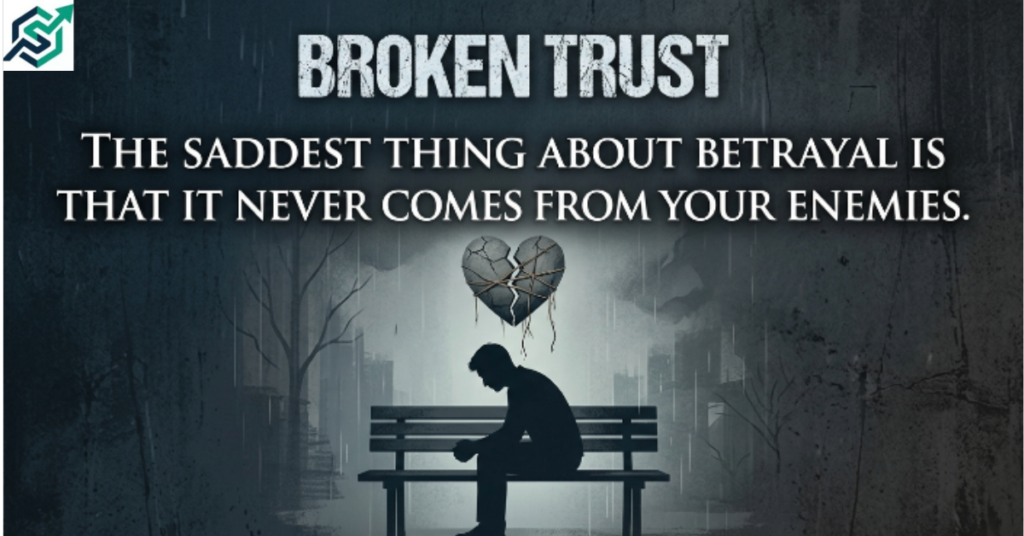
Trust, misplaced, does not just hurt in the moment of betrayal — it trains you toward caution that can make future authentic connection more difficult. These quotes sit with the specific weight of having trusted genuinely and being answered with deception.
- Trusting the wrong person does not make you naive. It makes you someone who defaulted to the better assumption about human beings — and learned, at cost, where one specific human being fell short.
- The worst thing about trusting the wrong person is not the betrayal itself — it is the specific, quiet voice afterward that asks whether your judgment can be trusted at all.
- You shared things with them that you had not shared with anyone. The fact that they did not protect those things says nothing about whether they were worth sharing. It says everything about whether they were worth sharing with.
- Misplaced trust is not a character flaw — it is the natural result of extending good faith to someone who was not honest about who they were.
- The lesson of trusting the wrong people is not “trust less.” It is “observe longer and more carefully before trusting fully.” Those two conclusions feel similar but lead to very different futures.
- The person you trusted was not entirely fake — they were a real person whose fear, insecurity, or self-interest exceeded their commitment to the relationship. Understanding that does not reduce the pain, but it does reduce the self-blame.
- Trust given openly and used against you creates a wound that takes time to articulate. For a long while it just feels like a reluctance to be known, like a door that does not quite fully open anymore.
- One of the heaviest things about trusting the wrong person is that the very qualities that made you vulnerable to them — your openness, your depth of feeling, your willingness to invest — are exactly the qualities you most want to preserve afterward.
- Misplaced trust teaches you that the problem was not in your capacity to trust but in your tendency to skip the observation period that trust, properly given, requires.
- After trusting the wrong person deeply, the challenge is not to become closed — it is to become discerning. Those two things are not the same, and the difference determines the quality of every relationship that follows.
Fake Family Members — Quotes for the Betrayal That Hits Hardest
Family betrayal by fake people carries a weight that social betrayal does not fully match — because family is the context in which we first learned what to expect from human relationships, and betrayal within it contaminates something foundational. These quotes acknowledge that specific, compounded pain.
- Family betrayal hurts differently because family is where you learned what trust was supposed to feel like — and their betrayal does not just hurt the present relationship, it reaches backward into your understanding of what relationship means at all.
- Fake family members are particularly skilled at weaponizing obligation. “Family sticks together” becomes a phrase used to prevent accountability rather than foster genuine connection.
- The cruelty of a fake family member is partly the proximity. You cannot always choose your distance, and they know it — which gives their behavior a particular confidence that non-family fake people rarely have.
- Growing up with a fake family member means learning to perform normalcy inside dysfunction — a skill that protects you in childhood and costs you significantly in adult relationships.
- Fake family members often style themselves as the honest one, the realistic one, the one who “just tells it like it is.” In practice, they are the one whose honesty is selectively deployed to harm and withheld when it might require accountability.
- The thing about fake family is that the institution of family surrounds them with protective language. Their behavior gets called “complicated” or “difficult” when in any other relationship it would simply be called dishonest.
- Holidays and shared events with fake family members require a specific performance tax — the sustained effort of acting fine inside a dynamic that is not, while everyone else pretends the dynamic is invisible.
- The love and the harm can coexist in the same family member — and the coexistence is what makes the situation so extraordinarily difficult to explain to people who have not lived inside it.
- Choosing distance from a fake family member is not abandonment. It is the decision that the relationship as it actually exists is not worth the cost it consistently extracts from you.
- You cannot logic your way out of family grief. You can only move through it honestly, allowing yourself to mourn both the family member you have and the one you needed them to be.
Quotes for When You Are Tired of Fake People
There comes a point beyond anger, beyond sadness, where the dominant feeling is simply exhaustion — a bone-deep fatigue at the ongoing performance that fake relationships require. These quotes honor that specific, legitimate tiredness.
- There is a particular tiredness that comes not from the dramatic betrayals but from the accumulated small performances of being around someone whose version of you is always slightly incorrect.
- Being tired of fake people is not cynicism. It is the natural result of repeatedly investing genuine energy in relationships that were not investing it back.
- At some point the energy required to maintain awareness of someone’s fakeness costs more than simply removing them from the equation. That point is a legitimate threshold, not a giving up.
- The exhaustion of fake people is partly about the cognitive load — the constant background processing of what they actually mean versus what they say, what they intend versus what they perform.
- Being tired of performing wellness in a fake relationship is your emotional system’s way of informing you that the relationship has exceeded the cost it is worth.
- Tired of fake people does not mean tired of people. It means your standards have clarified to the point where performing a relationship no longer feels acceptable as a substitute for having one.
- When you reach the stage of being tired rather than hurt, something important has shifted — you have stopped expecting better from people who have shown you consistently who they are.
- There is a version of tired-of-fake-people that is actually early wisdom — the recognition that your finite emotional energy belongs in places where it is genuinely received.
- Exhaustion with fake people sometimes precedes the decision to leave before the reasoning catches up. The body reaches its limit and simplifies what the mind has been overcomplicating for months.
- The tiredness is valid. The tiredness is real. The tiredness is your wellbeing insisting, with increasing urgency, on being taken seriously.
Savage Truths — Quotes That Expose Fake People Without Apology
These quotes are for the moments beyond sadness — for when clarity arrives with edges, when you see the situation without the softening of emotional investment, when the truth does not require gentleness to be useful.
- The most accurate thing you can say about a fake person is not that they are evil — it is that their self-interest consistently outweighed their integrity in every moment that mattered.
- Fake people are skilled at making their convenience look like your dysfunction. Watch for the pattern where every problem somehow returns to being about you.
- A fake person’s public performance of your friendship is often more convincing than the friendship itself, because the audience is the point.
- The best thing fake people do for you is show you, in precise detail, exactly what you refuse to become.
- Fake people are not usually lying about their affection — they are lying about its depth, its durability, and the conditions under which it will disappear.
- When a fake person needs something from you, they are at their most convincing. Study that version of them carefully, because it tells you everything — including what the friendship actually is.
- The thing about fake people is that they are often more aware of your value than genuine people are, because they are the ones who calculated it.
- Fake people recycle the same performances for each new person in their life. You were not special to their deception — you were simply next in a long, consistent pattern.
- The cold clarity of seeing someone’s fakeness fully is not comfortable, but it is clean — and clean, after sustained confusion, is its own form of relief.
- Fake people are exhausted by genuine people because genuine people require something that performance cannot replicate: actual presence.
Quotes About Growing Stronger After Fake People Leave
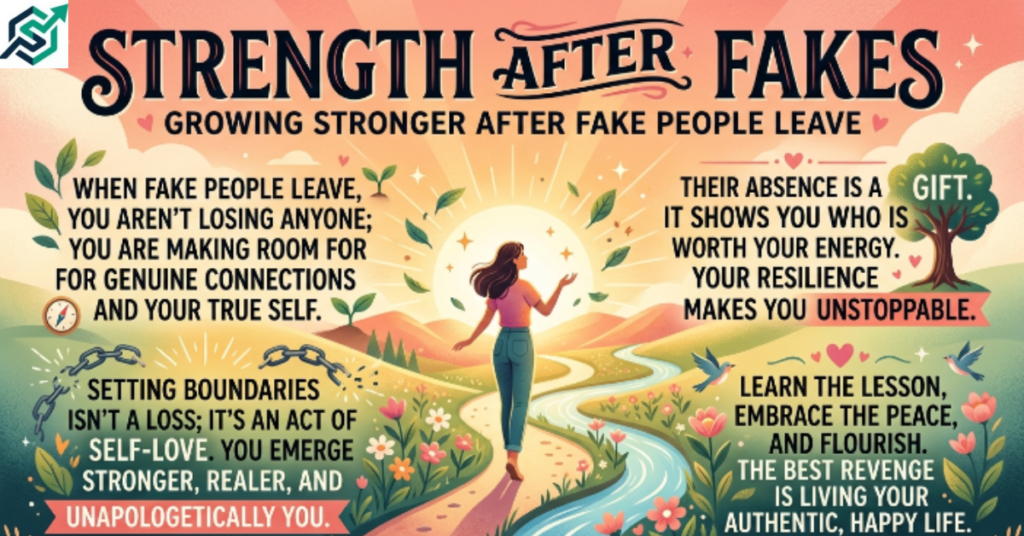
Growth after betrayal is not a cliché — it is a documented psychological process. The experience of being deceived, survived and processed honestly, builds a specific kind of discernment and self-knowledge that comfort alone cannot create. These quotes acknowledge the growth without minimizing what it cost.
- What grows in the space where a fake person used to be is a more honest understanding of what you actually need from the people you let close.
- The version of you that exists after surviving a fake friendship is more careful, more boundaried, more certain of what friendship is supposed to feel like. That is not damage. That is development.
- Growth after betrayal is not linear. Some days you feel clearly stronger. Other days the old wound announces itself. Both are normal steps in the same direction.
- Fake people are accidental teachers. They teach you, at unavoidable cost, the precise difference between someone who performs loyalty and someone who practices it.
- Every fake person who failed you refined your definition of what genuine relationship requires. That refinement is yours permanently. They cannot take it back with them when they go.
- The emotional intelligence you built navigating a fake person’s behavior — the pattern recognition, the attention to inconsistency, the awareness of what safety actually feels like — that is real, durable, hard-won knowledge.
- Growing after betrayal includes learning to receive genuine care without flinching — which is harder than it sounds when your system has been trained to expect deception inside warmth.
- The trust you rebuild in yourself after a fake person is sturdier than the trust you had before, because it is now based on evidence rather than assumption.
- Fake people pushed you toward the most important relationship you will ever have to repair — the one with your own judgment. That repair work is the real growth.
- You will be more careful. You will observe longer before trusting fully. You will notice inconsistencies earlier. These are not wounds — they are calibrations.
Heartbreak Quotes About Fake Love and Conditional Caring
Fake love is more complicated than its absence, because it requires you to process both the loss of the relationship and the retroactive revision of its meaning. These quotes sit with that specific, doubled grief.
- Fake love does not feel fake while you are inside it. It feels like love that is sometimes difficult — which is how real love also feels, which is precisely the confusion.
- The heartbreak of fake love is not just about the person. It is about the future you had imagined, the plans you had made, the vulnerability you had extended — all of it requiring revision simultaneously.
- Conditional love trains you to earn what should be freely given. The unlearning is slow and requires more patience than the original learning did.
- When the love turned out to be fake, the good memories do not simply disappear — they become complicated, requiring you to hold what was genuinely warm alongside what was ultimately not real enough.
- The grief of fake love has no clean edge. It is not the sharp grief of clear loss — it is the ambiguous, disorienting grief of not being entirely sure what you actually lost.
- You loved genuinely. That is not nothing. The fact that it was not matched in kind does not retroactively diminish the quality of what you offered.
- Fake love often comes with moments of real tenderness, which is what makes it so difficult to name and so difficult to leave. Real cruelty is easier to respond to than intermittent warmth.
- The thing about conditional love is that you spend enormous energy trying to understand and meet the conditions — energy that, in a genuinely loving relationship, you would have spent simply being known.
- After fake love, the task is not to stop loving deeply. It is to ensure that your depth of love is directed toward people whose capacity matches your commitment.
- You were not wrong to love them. You were working with incomplete information. When the complete picture became available, you made different choices. That is not failure — that is how human beings are supposed to function.
Self-Awareness Quotes — What Fake People Taught You About Yourself
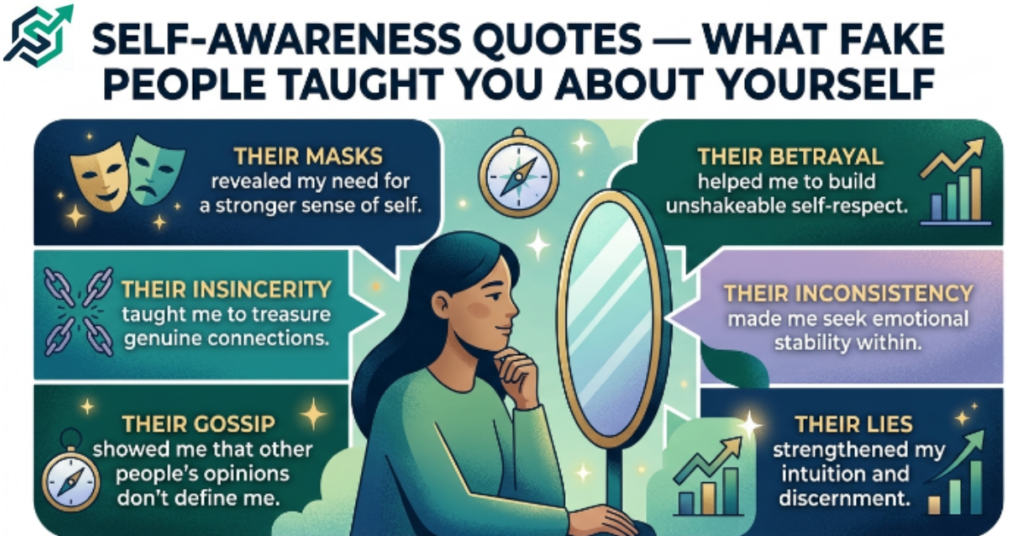
The most unexpected gift of navigating fake people is the self-knowledge that the experience forces. You learn where your boundaries are by discovering they were crossed. You learn what you value by experiencing its absence. These quotes honor that difficult, valuable process.
- Fake people reveal your strengths most clearly — because your strengths are often precisely what they were trying to borrow without acknowledgment.
- Surviving a fake friendship shows you how much capacity for genuine connection you actually have — the investment you made, even misplaced, is evidence of your relational depth.
- You discovered your boundaries by having them consistently violated. That is not the preferred method of learning, but it is one of the most thorough.
- What fake people teach you about yourself is often more lasting and accurate than what comfortable relationships reveal — because discomfort is a more honest mirror than ease.
- One of the most important things a fake person teaches you is what your own red flags look like — the specific sensations, the subtle inconsistencies, the quiet unease you learned to override and now know to honor.
- After a fake person, you understand more precisely what you need from genuine relationships, because you lived for a period inside their absence and now know exactly what was missing.
- The self-awareness born from betrayal is not always welcome — but it is durable. You carry it forward into every relationship after, and it makes you a more conscious participant in connection.
- Fake people show you the parts of yourself that are most vulnerable to exploitation — not so you can harden them, but so you can protect them more thoughtfully.
- The patience and empathy you extended to a fake person are not qualities you wasted — they are qualities you confirmed in yourself under the most testing conditions available.
- What you know about yourself after a fake person is richer, more specific, and more honest than anything you knew before. That knowledge is yours. They cannot take it.
Quotes About Walking Away and Protecting Your Energy
The decision to walk away from fake people is rarely dramatic in the way films suggest. More often it is quiet, tired, and accompanied by a grief that does not always make sense until much later. These quotes honor every version of that departure.
- Walking away from a fake person does not require their understanding or their agreement. It requires only your decision, made as many times as necessary, to honor your own wellbeing.
- The quietest departures from fake people are often the most complete. You do not always need a final scene. Sometimes you simply stop being available, and the relationship ends in the most honest way it could — by revealing it was only yours to maintain.
- Protecting your energy from fake people is not cruelty. It is the recognition that your emotional resources are finite and their claim on them was never legitimate.
- When you stop performing the relationship, the fake person’s response tells you everything — those who genuinely cared will notice the shift and ask. Those who were performing alongside you will simply redirect their performance elsewhere.
- Walking away with grace is not the same as walking away without grief. You can leave a fake relationship cleanly and still mourn it fully. Both things are available to you simultaneously.
- Energy protection after fake people is not about building walls — it is about installing gates. The difference is everything. Walls keep everyone out. Gates allow the right people through while the wrong ones find the entry unavailable.
- Your peace is not a negotiable resource. Fake people negotiate with it constantly, subtly, often without your conscious awareness. Walking away is the renegotiation.
- The people who drain you most often mistake your depletion for availability. Walking away is how you correct that misunderstanding permanently.
- When you choose your energy over someone’s comfort, you are not being selfish — you are honoring the finite nature of what you have to offer and ensuring it reaches the people most worthy of receiving it.
- The distance you created was not abandonment. It was architecture — the deliberate construction of an environment in which your authentic self can actually function.
Deep Fake People Quotes for the Ones Who Think Too Much
Some people process betrayal analytically — turning the experience over and over, looking for the mechanism, trying to understand the full architecture of what happened. These quotes are for those people, written at the depth the thinking requires.
- The psychology of fake people is not simple malice — it is the complex intersection of unexamined self-interest, fear of genuine intimacy, and a relational style that learned to perform rather than be.
- Fake people often do not experience themselves as fake. They have constructed a narrative in which their behavior is reasonable, their selfishness is survival, and their inconsistency is everyone else’s problem.
- The cognitive dissonance of a fake relationship — holding the experience of warmth alongside the evidence of deception — is one of the most mentally taxing states available. Your confusion was not weakness. It was the natural result of receiving genuinely contradictory data.
- Understanding why someone became fake does not obligate you to remain in the path of the behavior. Empathy and self-protection are not mutually exclusive.
- The pattern recognition you developed inside a fake relationship — the sensitivity to inconsistency, the awareness of performance — is a form of emotional intelligence that took significant pain to acquire and will serve you for the rest of your life.
- Fake people are most effective with people whose empathy and fairness prevent them from reaching conclusions quickly. Your thoughtfulness was not a flaw — it was a quality being exploited by someone less scrupulous than you.
- The relationship between trauma and fake people is real — people who grew up in environments where love was conditional or inconsistent often find themselves drawn to fake people because the dynamic feels familiar, and familiarity is mistaken for comfort.
- Deconstructing a fake relationship requires holding complexity: they were real in some ways and fake in others, they caused genuine harm and possibly experienced genuine feeling, you were genuinely wronged and also genuinely participated in something that had its own depth. All of this is simultaneously true.
- The most honest reckoning with a fake person includes the part where you examine what needs of yours the relationship met — even imperfectly, even manipulatively — because that examination points toward the genuine version of what you were actually looking for.
- Understanding fake people fully is not the same as forgiving them, and forgiving them is not the same as maintaining access to you. Each of these is a separate decision, available on its own timeline, independent of the others.
Sad But True Quotes About Human Nature and Deception
These quotes zoom out from individual relationships to the broader, more uncomfortable truths about human nature, social performance, and the way deception functions in human community — honestly, without cynicism.
- Deception is not aberrant human behavior. It is, unfortunately, a deeply embedded social skill that most humans develop early and many deploy regularly with varying degrees of awareness.
- The sad truth is that some people are fake not because they are malicious but because they are frightened — of intimacy, of inadequacy, of what genuine connection would require them to risk.
- Social performance and genuine connection exist on a spectrum, and most relationships contain some of both. The question is not whether someone is ever performing — it is whether the performance has replaced the substance entirely.
- Human beings are capable of simultaneously caring about someone and treating them dishonestly. The coexistence of these things is uncomfortable but real, and acknowledging it complicates the comfortable categories of real and fake.
- The capacity for self-deception in fake people is often remarkable — they genuinely believe the version of themselves they perform is real, which is why they are so authentically offended when their behavior is accurately named.
- Fake people are produced by environments and experiences before they become patterns in relationships. Understanding the production does not excuse the product, but it does explain why the same patterns appear so reliably across different people and contexts.
- The social scripts around loyalty, friendship, and love are sophisticated enough that people can follow them convincingly without ever fully embodying the values underneath them.
- Sad but true: some of the people who speak most eloquently about loyalty are the ones with the most complicated relationship to it in practice.
- The world is not full of fake people — but it contains enough of them, distributed widely enough, that almost everyone will encounter one in a context that matters deeply to them. This is not pessimism. It is statistical reality.
- The existence of fake people does not make genuine ones harder to find — it makes them more recognizable, more valued, and more deeply appreciated when they arrive.
Growth Quotes — What You Become After Fake People Shape You
The final section of this collection is about what comes after — not the false positivity of “everything happens for a reason,” but the earned, honest recognition that surviving fake people changes you in ways that, ultimately, tend toward strength.
- The person you become after fake people is more specific about what they need, more honest about what they will not accept, and more deeply grateful for relationships that are real.
- Every fake person you survived added a layer of discernment to your relational intelligence that no comfortable experience could have provided.
- Growth after fake people is not the growth of becoming harder. It is the growth of becoming more honest — about yourself, about others, about what you will and will not continue to accept.
- What you carry forward from fake relationships is not primarily damage, although the damage is real. What you carry forward is clarity — earned, costly, and ultimately more valuable than the comfort it replaced.
- The relationships you build after fake people are different in a specific way: you are more present in them, more honest, more willing to name things early, because you know now the cost of letting them go unnamed.
- After fake people, you recognize genuine ones differently. Their consistency stands out. Their accountability registers as significant. Their willingness to stay present in difficulty feels important in a way it might not have before.
- Growing beyond fake people requires forgiving yourself for not seeing it sooner — and understanding that the delay was not stupidity but humanity, not weakness but the natural reluctance to revise a relationship you had genuinely invested in.
- You are now someone who knows the difference between performed loyalty and practiced loyalty, between conditional affection and genuine care. That knowledge cost something real. It is also irreplaceable.
- The emotional capacity that survived fake people is larger than the one that preceded them — not because pain makes you bigger, but because navigating it honestly requires you to stretch toward dimensions of yourself you might not have accessed in comfort.
- What you deserve, on the other side of every fake person, is a relationship where your investment is matched, your vulnerability is protected, and your presence is valued not for what it provides but simply for what it is. That relationship exists. You are now better equipped to recognize it.
85 Additional Quotes Across Every Category
On Betrayal

- Betrayal by a fake person does not just hurt the relationship — it temporarily contaminates your relationship with your own confidence in reading people.
- The sting of betrayal is proportional to the depth of trust that preceded it. That proportion is not your fault — it is evidence of how genuinely you invested.
- Betrayal teaches you that the question is never “could this person hurt me” — the question is always “are they the kind of person who would.”
- The most honest thing about betrayal is that it simplifies a complicated situation. Before it, you had doubts. After it, you have clarity. Clarity is painful. Clarity is also better.
- Betrayal by someone fake does not mean you were foolish to trust them. It means they were not trustworthy — a fact about them, not a verdict about you.
On Loyalty
- Real loyalty does not require perfect conditions. It is the thing that stays when conditions are difficult and the easy option is to leave.
- The fake person’s version of loyalty is entirely conditional, which means it is something else wearing loyalty’s clothes.
- You cannot purchase genuine loyalty through enough accommodation, enough forgiveness, or enough patience. If the loyalty was not there, the absence was about the person, not the terms.
- Loyalty that needs to be constantly reassured and proven is fragile in a way that genuine loyalty simply is not.
- Giving real loyalty to someone performing fake loyalty is one of the most exhausting mismatches available in human relationship. The mismatch was not your failure — it was the situation.
On Healing
- Healing from fake people is not a return to who you were before — it is the construction of someone more honest about what they need and less willing to pretend otherwise.
- The first stage of healing is often anger. The anger is appropriate. It is your sense of justice activating after a long period of suppression. Let it exist without performing it.
- Healing requires going back through the relationship honestly — not to assign blame, but to understand clearly what happened so you can learn from it without repeating it.
- One sign of genuine healing is that you can discuss the fake person without the story consuming you — when the narrative becomes something you have, rather than something that has you.
- Healing from betrayal includes making peace with the version of yourself who did not see it coming — who trusted before trust was warranted, who stayed longer than was wise, who extended generosity that was not deserved. That version of you was not wrong. It was simply operating with incomplete information.
On Moving Forward
- Moving forward after fake people is not forgetting them — it is integrating the experience into your understanding of yourself and others in a way that serves your future.
- The forward movement is not always dramatic. Sometimes it is just waking up one morning and noticing the absence of the weight that used to accompany thoughts of them.
- You will meet genuine people. The fake ones do not represent the full range of what human relationship can offer — they represent a specific subset of it that you are now better equipped to recognize and avoid.
- Moving forward means carrying the lesson without carrying the wound. That distinction, lived rather than stated, is what genuine recovery looks like.
- The future after fake people is not a lesser future — it is a more discerning one, populated by people who earned their place in it more carefully than the ones who came before.
On Self-Worth
- Your worth was never determined by a fake person’s assessment of it. Their assessment was always shaped by their needs, not your value.
- The fact that a fake person chose you reflects their accurate recognition of your qualities. Their failure to honor those qualities reflects their limitations, not yours.
- Fake people are often drawn to genuinely valuable people — people whose warmth, depth, and loyalty are real assets. The tragedy is not in being chosen by them. It is in what they did with the choice.
- Reclaiming your self-worth after a fake person means separating what happened from what it means — understanding that being deceived does not make you less valuable, less perceptive, or less worthy of genuine love.
- Your value does not decrease when someone fails to see it accurately. A painting does not become less significant because a particular viewer misunderstood it.
On Recognition and Red Flags
- A red flag seen and ignored is not a red flag you missed — it is a red flag you overrode, which is a different problem with a different solution.
- Red flags often look like personality quirks until the pattern becomes undeniable. That is not a failure of observation — it is the natural result of giving the benefit of the doubt.
- The red flags you will recognize most quickly next time are the specific ones you dismissed this time. That is not a comfortable thought, but it is a useful one.
- Trust your discomfort earlier than you trust your explanations for it. Discomfort is faster than logic and often more accurate.
- The recognition of red flags is a skill that develops through experience — which means everyone who develops it has paid for the education in a way they would not have chosen voluntarily.
On Authentic Connection
- Authentic connection feels different from performed connection in a way that is difficult to articulate and immediately recognizable once you have experienced both.
- The intimacy you were looking for inside a fake relationship is real — it exists, it is available, it simply was not present in that particular person.
- Genuine people are quieter about their loyalty than fake ones. They prove it consistently in small ways rather than announcing it dramatically in large ones.
- Real friendship does not require you to perform a version of yourself — it requires you to simply be the version of yourself you already are, and to find that version sufficiently interesting and valuable.
- Authentic connection after fake people feels almost suspicious at first — the consistency, the follow-through, the absence of an angle. Allow yourself to adjust to it. Allow yourself to receive it.
Final Reflections
- The story of a fake person in your life is not primarily a story about them — it is a story about your capacity to love genuinely, your willingness to invest, your resilience in the face of discovering the investment was misplaced.
- Every person who survives a fake relationship and chooses to remain open to genuine connection is making a courageous decision that deserves more recognition than it typically receives.
- The sadness of fake people is real and it deserves to be felt. But underneath the sadness is something important: evidence of your capacity for authentic connection, which the fake person could not provide but could not eliminate either.
- You are not diminished by what happened. You are, in ways still becoming clear, enlarged by how you are choosing to move through it.
- The end of a fake relationship is the beginning of the space required for a genuine one. That space is not empty. It is the most important thing you have made room for in a long time.
45 Final Short Truths
- Fake people need audiences. Remove yourself from theirs.
- Performed warmth and real warmth feel identical until tested.
- The most loyal people in your life are often the quietest about it.
- Anger after betrayal is not bitterness — it is accuracy.
- Some goodbyes are gifts that take years to unwrap.
- Betrayal clarifies priorities in ways that comfort never could.
- Fake people are consistent — consistently performing, consistently self-serving, consistently the same.
- What they said about you says nothing about you and everything about them.
- Your openness was not the problem. Their dishonesty was.
- The relationship that cost you your peace was always priced too high.
- Genuine people exist. You have simply been in the wrong room.
- Not every closed door is a loss. Some are protection.
- The silence after cutting someone off is uncomfortable because it used to be filled with noise. Noise was not the same as company.
- Your loyalty deserved a match it did not receive. That mismatch was the problem.
- You were not too trusting. They were not trustworthy. Different problems.
- Some people leave your life and take nothing real with them.
- Growth is quiet. Fake people are loud. Eventually, quiet wins.
- You were the most real thing in that relationship. That matters.
- Learning to trust your gut is worth every false start.
- Fake people are remarkably consistent — at being inconsistent with everything except their self-interest.
- The grief of a fake friendship is legitimate. Grieve it properly.
- Every boundary you set now is a letter to your past self explaining what you learned.
- Genuine people do not require you to audit their behavior. They simply behave.
- You gave something real to someone who gave back a performance. The exchange was not equivalent. The fault was not yours.
- The most powerful thing you can do after fake people is refuse to become one.
- Chose yourself, even after someone else refused to.
- Your healing does not require their acknowledgment.
- The version of you emerging from this is more honest, more boundaried, and more certain of your worth than before.
- Some lessons can only be learned from the wrong people. You have learned them.
- Peace after fake people is not forgetting. It is releasing the need for them to understand what they did.
- You do not have to become suspicious of everyone to protect yourself from someone specific.
- What they lost when they lost you is more than they understood at the time.
- Being too real for a fake person is the highest compliment the situation contains.
- You survived the confusion. That is not a small thing.
- What comes after fake people is not automatically better — but it is available, and you are now more prepared to receive it.
- Forgiving fake people is for you, not for them. The distinction is everything.
- You cannot make a fake person real through the quality of your love. That is not a limitation of your love.
- Some relationships teach you exactly what you will not settle for. That is a curriculum worth the cost.
- The version of you who finally walked away was braver than you know.
- Genuine connection is coming. The fake ones were not it — and now you know the difference.
- You were never the problem. You were the person the problem found.
- What remains after fake people leave is the truest version of yourself.
- The journey back to trusting yourself is the most important trip you will make.
- You are allowed to be sad about what was fake and still be grateful for what it revealed.
- Everything that happened built something in you that nothing could take away. Find it. Keep it. Build on it.
The Psychology Behind Fake People — What Research Actually Says
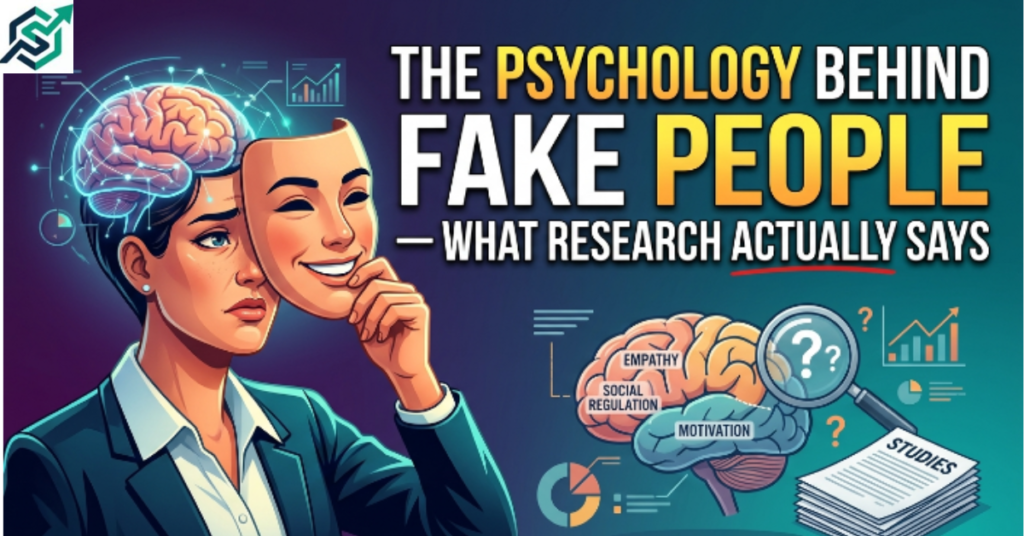
Understanding the psychological underpinnings of fake behavior provides something more useful than vindication — it provides a framework for recognizing patterns earlier and investing energy more wisely in the future.
Attachment Theory and Fake Behavior
Psychologists working in attachment theory suggest that many people who exhibit fake behavior in adult relationships learned early that authentic self-expression carried risk. If expressing genuine needs in childhood resulted in withdrawal of care, the learned adaptation is to perform a version of self that produces safety. This pattern often persists into adulthood, producing people who are genuinely skilled at performing closeness without the capacity or willingness to sustain it.
Self-Monitoring Behavior
Research in social psychology identifies “high self-monitors” — individuals who are highly attuned to social cues and adjust their presentation accordingly. While moderate self-monitoring is a social skill, extreme self-monitoring can produce the behavior most commonly experienced as fakeness: a presentation so calibrated to its audience that it loses continuity across contexts.
Narcissistic Traits and Transactional Relationships
People with narcissistic personality traits often engage in relationships transactionally — the relationship is maintained as long as it provides admiration, utility, or status, and discarded when it does not. This pattern is not always conscious, but it produces the experience in the other person of conditional care and performed loyalty.
The Betrayal Trauma Response
Research by psychologist Jennifer Freyd documents that betrayal by close others — particularly those on whom we depend — produces a specific trauma response distinct from stranger-inflicted harm. The brain’s threat-detection system is suppressed in close relationships as a function of dependency, which is why betrayal from people we trusted often feels more disorienting than harm from strangers.
Understanding these mechanisms does not make the experience less painful. But it relocates the cause from your judgment to their patterns — and that relocation is an important part of healing.
How to Recognize Fake People Earlier — A Practical Guide
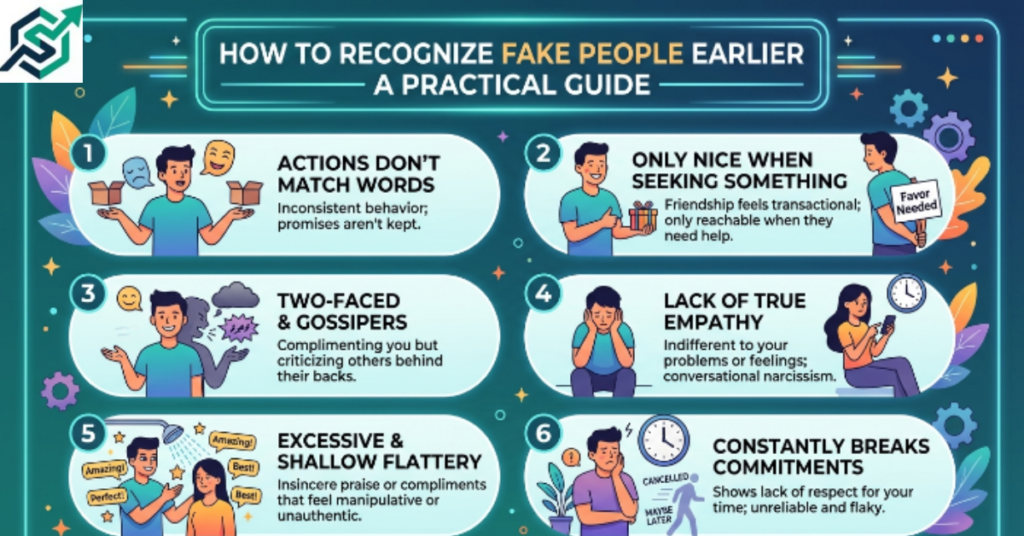
The goal is not hypervigilance — it is calibrated observation. Here are the most reliable early indicators, drawn from psychology and lived experience:
Watch for inconsistency between public and private behavior.
How does this person speak about others when those others are not present? If they are consistently negative, strategic, or dismissive in private while performing warmth publicly, you are observing a pattern that will eventually be directed at you.
Notice how they respond to your success.
Genuine people celebrate your wins with enthusiasm proportional to their care for you. Fake people respond to your success with muted enthusiasm, subtle qualifiers, or a redirect to their own experience. This pattern is reliable.
Observe their behavior in crisis.
Genuine people show up when things are difficult. Fake people find reasons to be unavailable or, if present, find ways to make your crisis about them.
Track consistency over time.
Fake people are not consistently bad — they are inconsistently good. The inconsistency itself is the signal.
Notice how you feel after interactions.
If you consistently feel slightly worse about yourself after spending time with someone, that is meaningful data. Genuine people leave you feeling seen. Fake ones leave you feeling subtly managed.
Conclusion
The experience of fake people is one of the most universally human experiences available — which means you are not alone in it, you are not uniquely foolish for having been susceptible to it, and you are not permanently marked by it.
These 250+ sad fake people quotes were written to accompany every stage of the experience — the slow recognition, the painful clarity, the grief, the anger, the careful decisions about distance and boundary, and the eventual, genuine growth that emerges when the experience is processed honestly rather than merely survived.
Loyalty, when you encounter it genuinely, will feel different than you expected. Not dramatic, not loudly declared — quieter and more consistent, more present in difficulty, more honest in the moments that require honesty. You will recognize it not because it announces itself but because its consistency, over time, becomes undeniable.
That recognition is worth everything fake people cost. Not because the cost was fair — it was not. But because you are now equipped to receive and protect something real when it arrives.
It will arrive.
FAQs
Why do sad fake people quotes feel so relatable?
Because the experience of encountering fake people — discovering that someone you trusted was performing rather than genuinely investing — is near-universal. The quotes resonate because they name something that many people have lived but found difficult to articulate. Recognition is validating; validation reduces the isolation that betrayal deliberately creates.
How do you tell the difference between a fake person and someone going through a difficult time?
The most reliable distinguisher is pattern versus episode. Everyone behaves less than their best selves during periods of stress, grief, or crisis. Fake behavior, by contrast, is a consistent pattern across different contexts and time periods. A friend who withdraws during their own divorce is experiencing an episode. A friend who is consistently unavailable during your difficulties but present for your ease is demonstrating a pattern.
Is it possible for someone to be genuinely unaware they are being fake?
Yes, and research supports this. Many people with fake behavioral patterns have constructed self-narratives in which their behavior is reasonable, their self-interest is survival, and the inconsistency they create in others is those others’ problem. The lack of conscious awareness does not reduce the harm caused — but it does explain why confrontation often produces genuine-seeming offense rather than accountability.
How do you heal without becoming closed off to new people?
The key distinction is between walls and gates. Walls prevent all entry. Gates allow entry with more careful observation. Healing means developing a more rigorous observation period before trust is fully extended — not refusing to trust, but making trust something that is earned through demonstrated consistency rather than assumed based on initial warmth.
What is the most important thing to do after a fake friendship ends?
Resist the temptation to immediately revise your entire worldview toward cynicism, and resist the temptation to rush past the grief by insisting you are fine. The most important thing is to process the experience honestly — ideally with a trusted person or therapist — so that the lessons it contains are genuinely integrated rather than converted into either a wall or a wound.

I’m Grace Morgan, a professional content writer with 3+ years of experience and AI content writing expertise, creating clear, engaging, and easy-to-understand content for readers.
