

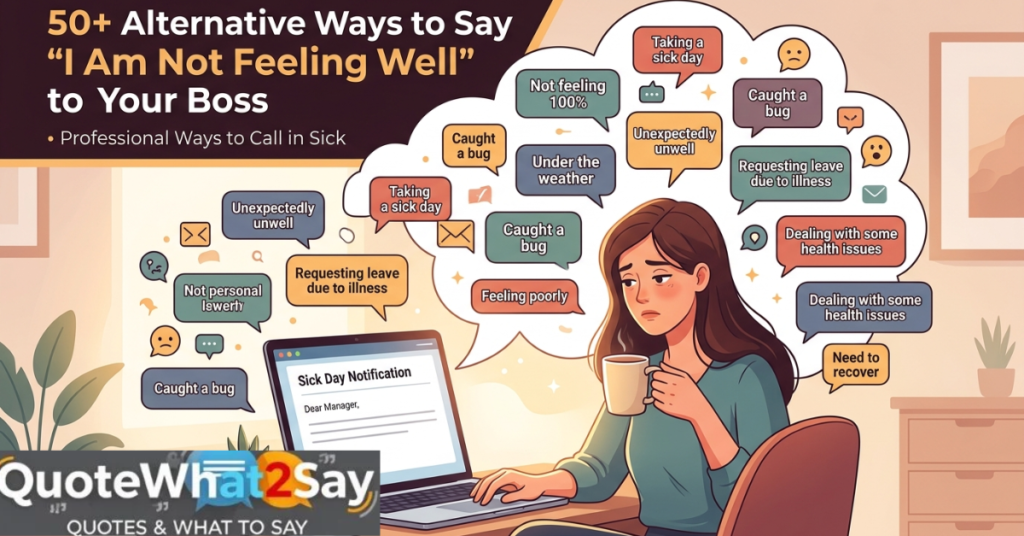
Telling your boss that you’re not feeling well seems simple — but the way you say it can make a big difference. A poorly worded message can sound unprofessional, vague, or even suspicious. A well-crafted one builds trust and keeps your workplace reputation intact.
Whether you’re sending a quick text, writing a formal email, or hopping on a call, having the right words ready matters. This guide gives you 50+ professional, polite, and natural alternatives to “I am not feeling well” — with real conversation examples, usage tips, and advice on when to use each one.
Why Word Choice Matters When You’re Sick
Before jumping into the list, here’s a quick reality: your boss reads dozens of messages a day. A message that is clear, respectful, and professional will always get a better response than one that feels lazy or vague.
Using varied, thoughtful expressions also shows:
- Emotional intelligence — you understand the workplace context
- Professionalism — you respect your boss’s time
- Reliability — even while sick, you communicate clearly
Now, let’s get into the full list.
50+ Ways to Say “I Am Not Feeling Well” to Your Boss
1. “I’m Feeling Under the Weather”
When to use: Casual to semi-formal workplaces. Perfect for a quick message or text.
Example:
You: Hi [Boss], I wanted to let you know I’m feeling under the weather today. I may need to take the day off to rest. I’ll keep you updated. Boss: No worries, rest up and feel better soon.
Tip: This is one of the most widely understood and accepted expressions. It’s friendly without being too casual.
2. “I’m Not Feeling My Best Today”
When to use: When you’re still unsure if you’ll need the full day off.
Example:
You: Good morning. I’m not feeling my best today — I’ll try to get some work done from home, but I may need to step away if things don’t improve. Boss: Understood. Take it easy.
Tip: This phrase leaves room for flexibility, which is great for remote workers.
3. “I’m Feeling Unwell Today”
When to use: Any professional setting — emails, messages, or in-person.
Example:
You: I wanted to give you a heads-up — I’m feeling unwell today and would like to request sick leave. Boss: Of course. Let us know if you need anything.
Tip: Clean, simple, and professional. Works in almost every industry.
4. “I’m Not Feeling Well Enough to Work Today”
When to use: When you need a full day off and want to be direct.
Example:
You: Hi, I’m not feeling well enough to work today and will be taking a sick day. I’ll respond to urgent messages if anything comes up. Boss: Take care. We’ll manage.
Tip: This leaves no ambiguity. Use it when you need a clear, firm message.
5. “I’m Dealing With a Health Issue Today”
When to use: Formal emails or when you prefer privacy about your symptoms.
Example:
You: Dear [Boss], I’m dealing with a health issue today and won’t be available for regular duties. I’ll be back as soon as I’m feeling better. Boss: Thank you for letting me know. Please rest.
Tip: This keeps your condition private while still being honest and professional.
6. “I’m Experiencing Some Health Issues”
When to use: Slightly more formal — good for written communication.
Example:
You: I wanted to inform you that I’m experiencing some health issues and may need to take the day off. Boss: Absolutely. We’ll cover your tasks.
Tip: Ideal when you want to sound professional without oversharing.
7. “I’m Feeling a Bit Sick Today”
When to use: Casual or friendly workplaces.
Example:
You: Hey, just a heads-up — I’m feeling a bit sick today. I might need to log off early if it gets worse. Boss: Got it. Feel better!
Tip: Works well in team chats or with a boss you have a casual rapport with.
8. “I’m Feeling Ill and Need to Rest”
When to use: When you’re genuinely feeling bad and need to prioritize recovery.
Example:
You: I’m feeling ill and need to rest today. I’ll keep my phone nearby for anything urgent. Boss: Please rest. We’ll handle it.
Tip: The added reassurance (“I’ll keep my phone nearby”) shows responsibility even while sick.
If you want to sound even more professional, check out our guide on Ways to Say Sorry to Your Boss.
9. “I’m Not in a Position to Work Today Due to Health Reasons”
When to use: Formal corporate settings or HR communications.
Example:
You: I’m writing to inform you that I’m not in a position to work today due to health reasons. I will provide a medical note if required. Boss: Understood. Take the time you need.
Tip: Adding “I will provide a medical note if required” shows professionalism and preparedness.
10. “I’m Feeling Unwell and Will Need Some Rest Today”
When to use: Mid-formality settings — a solid all-rounder.
Example:
You: Good morning. I’m feeling unwell and will need some rest today. I’ll be back tomorrow if I recover as expected. Boss: Take care. See you when you’re feeling better.
Tip: Setting an expected return date shows foresight and reliability.
11. “I’m Not Feeling Fit to Work Today”
Use when you want a slightly formal tone. Good for blue-collar or physically demanding jobs where “fitness to work” is a common concept.
12. “I’m Experiencing Discomfort and Need to Rest”
A gentle way to communicate without going into detail. Best when symptoms are personal or sensitive.
13. “I’m Not Well Today and Won’t Be Able to Work”
Direct and honest. Perfect for short messages or texts.
14. “I’m Feeling a Bit Unwell and Will Log Off Early”
Great for partial sick days. Shows you tried to work before stepping away.
15. “I’m Not Feeling Great Today”
Very conversational. Use with a manager you have a friendly relationship with.
16. “I’m Feeling Unwell and May Be Unavailable for Part of the Day”
Flexible and honest — perfect if you’re not sure how the day will go.
17. “I’m Not in Good Health Today”
Formal and appropriate for any professional email.
18. “I’m Feeling Sick and Need to Take It Easy”
Friendly and warm. Works well in team chats or with supportive managers.
19. “I’m Experiencing Some Health Concerns Today”
Professional phrasing that keeps your personal health details private.
20. “I’m Not Feeling Up to Work Today”
Conversational yet respectful — a natural-sounding option for most workplaces.
21. “I’m Feeling Unwell and Will Be Taking Sick Leave”
Formal and action-oriented. Best for structured workplaces with formal leave policies.
22. “I’m Not Well Enough to Be Productive Today”
Honest and self-aware — shows you understand the impact on work quality.
23. “I’m Experiencing Symptoms and Need Time Off”
Appropriate when you’ve been diagnosed or are following medical advice. Works well in formal emails.
24. “I’m Not Feeling Well and Will Be Offline Today”
Ideal for remote workers who need to communicate digital unavailability clearly.
25. “I’m Feeling Unwell and Will Not Be Available Today”
Professional and clear. Good for both in-office and remote scenarios.
26. “I’m Feeling Sick and Will Be Taking the Day Off”
Simple and direct. No room for misunderstanding.
27. “I’m Not Feeling Well Enough to Attend Work”
Slightly more formal — good for in-person workplaces where physical attendance is expected.
28. “I’m Experiencing Health Issues and Need to Rest”
Professional and empathetic tone. Works across industries.
29. “I’m Feeling Unwell and Need a Sick Day”
Clear and concise — great for a quick WhatsApp or Slack message to your manager.
30. “I’m Not Feeling Well and Will Update You Soon”
Thoughtful option when your situation is uncertain — keeps your boss in the loop without overpromising.
31. “I’m Feeling Unwell and Will Need to Take It Easy Today”
Gentle phrasing — good if you’re going to attempt light work but can’t commit to full productivity.
32. “I’m Not Feeling Well and Won’t Be Able to Join Today”
Perfect for meetings or video calls you need to skip.
33. “I’m Under the Weather and Could Use a Rest Day”
Friendly and conversational. Implies a short absence rather than a serious issue.
34. “I’ve Come Down With Something and Need to Stay Home”
Natural and relatable — sounds like something you’d actually say. Good for informal workplaces.
35. “I’m Feeling Off Today and May Need to Step Away”
Subtle and honest — great for when you’re not fully sick but genuinely can’t perform at your best.
36. “My Health Isn’t Great Today — I’ll Need Some Time to Recover”
Conversational and transparent. Works well with managers who appreciate directness.
37. “I’m Not at My Best Health-Wise Today”
Professional and understated. Good for formal workplaces where you prefer not to sound dramatic.
38. “I’m Battling Some Fatigue and Need to Rest”
Specific without being too personal. Good if exhaustion is genuinely your issue.
39. “I Have a Medical Issue That Requires Me to Rest Today”
Formal and respectful. Useful when you have a doctor’s recommendation to rest.
40. “I’m Suffering From Some Discomfort and Can’t Work at Full Capacity”
Thoughtful and professional — good when you’re partially available but not fully functional.
41. “I’m Feeling Quite Unwell and Think It’s Best I Rest Today”
Slightly formal, with good reasoning built in. Shows self-awareness.
42. “I’m Struggling With My Health Today and Need to Take a Break”
Honest and vulnerable — works with empathetic managers.
43. “I’m Not in the Best Shape Health-Wise and Would Like to Take the Day Off”
Polite and humble. Framing it as a request (“would like”) shows respect.
44. “I’m Running a Fever and Won’t Be Able to Come In”
Specific and credible — one of the most universally accepted reasons for absence.
45. “I’ve Been Feeling Sick Since Last Night and Need a Day to Recover”
Providing context adds credibility. Works well in formal emails.
46. “I’m Dealing With a Stomach Bug and Need to Rest at Home”
Specific but not oversharing. Widely understood and accepted.
47. “I’m Not Feeling Well — I’ll Keep You Posted on My Availability”
Great for ongoing situations where recovery is uncertain.
48. “I’ve Got a Bad Headache/Migraine and Won’t Be Able to Focus Today”
Specific and relatable. Migraines are widely recognized as debilitating — no explanation needed.
49. “I’m Feeling Physically Drained and Need a Recovery Day”
Appropriate for fatigue or burnout — keep it honest and professional.
50. “I Need to Take a Sick Day — I’m Not Well Enough to Be Effective Today”
Action-oriented and clear. The added reasoning (“not well enough to be effective”) shows professional responsibility.
51. “I’m Sorry to Inform You That I’m Unwell and Unable to Work Today”
Highly formal — best suited for written emails in corporate environments.
52. “I Woke Up Feeling Quite Ill and Don’t Think I Should Come In”
Natural and convincing. Provides a logical reason without oversharing.
How to Write the Perfect “I’m Sick” Message to Your Boss
Knowing what to say is only half the job. Here’s how to say it effectively:
1. Be prompt — Message your boss as early as possible, ideally before the workday begins.
2. Be clear — State directly that you’re unwell and whether you’ll be taking the day off or working partially.
3. Mention coverage — If possible, note who can handle your urgent tasks or that you’ll check messages periodically.
4. Set a return expectation — Let your boss know when you expect to be back.
5. Keep it concise — You don’t need to explain your symptoms in detail. A few sentences are enough.
Sample Email Templates

Template 1 — Full Day Off (Formal)
Subject: Sick Leave Request — [Your Name]
Dear [Boss’s Name],
I hope this message finds you well. I’m writing to inform you that I’m not feeling well today and will be unable to come in. I would like to take a sick day to rest and recover.
I’ll ensure any urgent matters are handled and will be available by phone if something critical comes up. I expect to be back tomorrow, health permitting.
Thank you for your understanding.
Best regards, [Your Name]
Template 2 — Partial Day (Semi-Formal)
Hi [Boss’s Name],
Just wanted to give you a heads-up — I’m feeling under the weather this morning. I’ll log in for a few hours but may need to step away early if I don’t improve. I’ll keep you updated.
Thanks for understanding. [Your Name]
Template 3 — Quick Text/Slack Message
Hi [Boss], I’m not feeling well today and will need to take a sick day. I’ll check messages in case anything urgent comes up. Hope to be back tomorrow!
Frequently Asked Questions
Q: Should I always give a reason when I’m sick? No. You’re not obligated to share your diagnosis. Saying “I’m not feeling well” or “I’m experiencing a health issue” is enough in most professional settings.
Q: Is it okay to text your boss when you’re sick? Yes, especially in modern workplaces. Just match the communication style your team uses. A quick Slack message or text is fine for most companies; a formal email is better for corporate environments.
Q: How much detail should I give? Keep it brief. Your boss needs to know you’re unavailable — not the full medical report. One to three sentences is usually ideal.
Q: What if I’m working from home — do I still need to tell my boss? Yes. Even remote workers should communicate when they’re too unwell to work effectively. Silence can be more damaging than a quick message.
Q: Should I offer to make up for the missed work? It can help, but don’t overpromise while you’re sick. A simple “I’ll catch up when I’m back” is usually enough.
Final Thoughts
Being sick is never convenient — but communicating about it professionally can make a real difference. Whether you go with something simple like “I’m feeling unwell today” or something more formal like “I’m not in a position to work today due to health reasons”, the key is to be honest, clear, and respectful.
Use this list as your go-to resource the next time you need to let your boss know you’re not at your best. Your boss will appreciate the professionalism — and you’ll feel better knowing you handled it the right way.

I’m Grace Morgan, a professional content writer with 3+ years of experience and AI content writing expertise, creating clear, engaging, and easy-to-understand content for readers.
