

Imagine receiving a simple text: 1437.
No words. No emojis. Just four numbers.
Yet the person who sent it just told you something deeply emotional — “I love you forever.”
This is the magic of number-based digital language. In a world where people communicate faster than ever, numbers like 1437 carry big emotions in tiny packages.
In this ultimate expert guide, you will discover:
- The exact meaning of 1437
- Its deep origin story
- How it evolved from 143
- Psychology behind why people use it
- 25+ real-life examples and dialogues
- When to use it — and when NOT to
- How it is used differently across cultures
- Modern usage in 2026
- Expert tips for using it correctly
- Full FAQ section
This guide is written in simple English so anyone can understand easily.
What Does 1437 Mean? (Crystal Clear Definition)
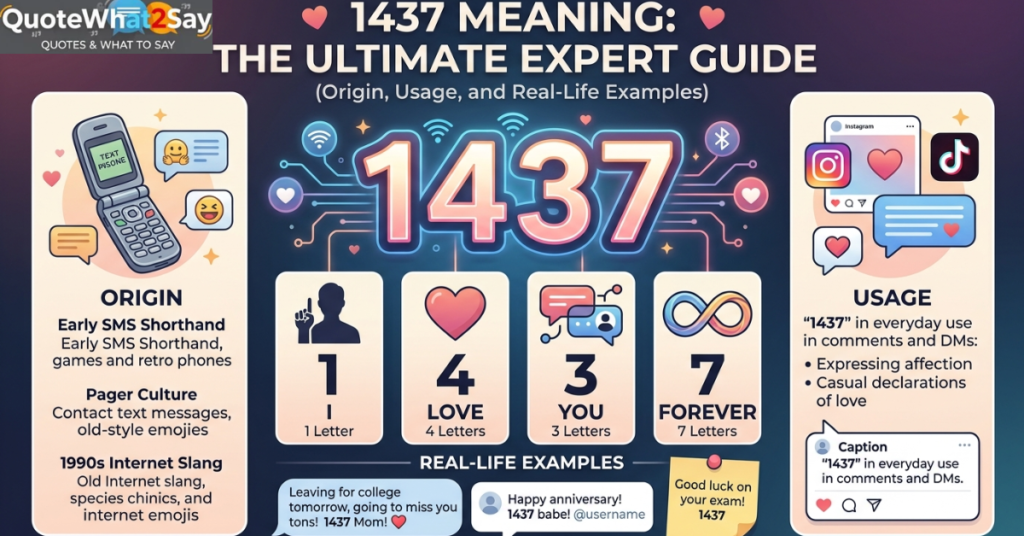
1437 means: “I Love You Forever.”
Here is how each number works:
| Number | Stands For | Letter Count |
| 1 | I | 1 letter |
| 4 | Love | 4 letters |
| 3 | You | 3 letters |
| 7 | Forever | 7 letters |
So: 1 + 4 + 3 + 7 = I Love You Forever
This is called a numeric code — where each number represents the letter count of a word.
Simple Rule: Count the letters in each word → that becomes the number.
- I = 1 letter → 1
- Love = 4 letters → 4
- You = 3 letters → 3
- Forever = 7 letters → 7
The Complete Origin & History of 1437

Step 1: It Started With Pagers (1980s–1990s)
Before smartphones existed, people used pagers (beepers). Pagers could only receive numbers — not text.
So people invented number codes to send messages:
- 143 = I Love You (most famous early code)
- 07734 = Hello (when read upside down on a calculator)
- 411 = Information
143 became the foundation for all love-number codes.
Step 2: The SMS Revolution (Early 2000s)
When mobile phones arrived, texting became popular. But early SMS had problems:
- Limited to 160 characters per message
- Typing on old keypads was very slow
- Sending long messages cost more money
So people shortened everything:
- “See you later” → CUL8R
- “I love you” → ILY or 143
- “Be right back” → BRB
Step 3: 1437 Is Born — Upgrading 143
People wanted to express something stronger than just “I love you.”
They wanted to say forever.
So 143 became 1437 — adding the number 7 for the word “forever” (7 letters).
This upgrade showed:
- Deeper commitment
- Long-term love
- Emotional permanence
Step 4: Social Media Makes It Viral (2010s–2020s)
Platforms like Instagram, TikTok, Twitter, and WhatsApp made 1437 go viral:
- TikTok users added it to bios and captions
- Instagram couples used it in anniversary posts
- WhatsApp chats used it as a secret love code
Step 5: 1437 in 2026
Today in 2026, 1437 is more popular than ever. It is used in:
- Dating apps
- Social media bios
- Text messages
- Voice note endings
- Even tattoos and jewelry
1437 vs 143 — Full Detailed Comparison
| Feature | 143 | 1437 |
| Full meaning | I Love You | I Love You Forever |
| Emotional depth | Basic love | Deep, permanent love |
| When to use | Casual / daily | Special moments |
| Relationship stage | Early dating | Serious relationships |
| Word count | 3 words | 4 words |
| Letter count | 1+4+3 = 8 | 1+4+3+7 = 15 |
| Formality | Casual | More serious |
| Popularity | Very common | Growing fast |
Bottom line: 1437 is the upgraded, more powerful version of 143.
Psychology Behind 1437 — Why People Use Numbers for Love
This is something your competitor did NOT cover. Here is the deep psychology:
1. Numbers Feel Permanent
Words can be deleted or forgotten. But numbers feel mathematical — exact and unchangeable. Saying 1437 feels like a formula for love — precise and permanent.
2. Secret Language Creates Intimacy
When only you and your partner know that 1437 means “I love you forever,” it creates a private world between two people. This private language deepens emotional connection.
3. Vulnerability Protection
Saying “I love you forever” out loud feels scary and vulnerable. But typing 1437 feels safer — it is indirect enough to reduce fear of rejection, while still carrying the full emotional weight.
4. Digital Native Identity
Young people today grew up with digital language. Using codes like 1437 is part of their cultural identity — it signals that they belong to the modern digital world.
5. Brevity = Sincerity
In an age of long captions and over-explained posts, a simple 1437 can feel MORE sincere than a paragraph of love words.
25+ Real-Life Examples of 1437
Text Message Examples
Example 1:
Person A: I’m going to sleep. Goodnight. Person B: Sweet dreams. 1437
Example 2:
Person A: I had the best day with you. Person B: Same. 1437, always.
Example 3:
Person A: Are you angry at me? Person B: Never. 1437.
Example 4:
Person A: I miss you so much right now. Person B: 1437. Come home soon.
Example 5:
Person A: Do you regret us? Person B: Not for one second. 1437.
Social Media Caption Examples
Example 6:
Caption: 3 years with my favorite person. 1437
Example 7:
Instagram bio: taken. 1437.
Example 8:
TikTok comment: You two are goals. 1437 energy!
Example 9:
Anniversary post: They say forever is a long time. I say not long enough. 1437.
Example 10:
Twitter/X post: Woke up next to my best friend again. 1437 hits different in the morning.
Long-Distance Relationship Examples
Example 11:
Person A: 5,000 miles away and you still feel close. Person B: Distance means nothing. 1437.
Example 12:
Person A: I counted — only 47 more days until I see you. Person B: 1437. Every single one of those days.
Example 13:
Person A: I hate that I can’t hug you right now. Person B: Virtual hug. 1437.
Emotional / Deep Moment Examples
Example 14:
After an argument: Person A: I’m sorry. I shouldn’t have said that. Person B: I know. 1437. Let’s move forward.
Example 15:
After a hard day: Person A: Today destroyed me. Person B: I’ve got you. Always. 1437.
Example 16:
During illness: Person A: I feel so weak. Person B: I’ll be right there. 1437. You’re not alone.
Creative / Fun Examples
Example 17:
Valentine’s Day card: Roses are red, violets are blue, 1437, and that means forever with you.
Example 18:
On a gift tag: For my 1437 person.
Example 19:
Morning text: Good morning, 1437. Coffee is ready
Example 20:
After a date: Tonight was perfect. 1437.
Friendship (Rare but Possible) Examples
Example 21:
Best friends: Person A: You’ve been there for everything. Person B: Always will be. Platonic 1437.
Example 22:
To a parent: Child: Mom, 1437. Thank you for everything.
Full Dialogues Using 1437
Dialogue 1 — First Love Confession
A: I need to tell you something. B: What is it? A: 1437. B: …Did you just confess in numbers? A: I was nervous. Is that okay? B: It’s perfect. 1437 back.
Dialogue 2 — Long Distance Check-In
A: How was your day? B: Exhausting. Yours? A: Same. But I thought about you all day. B: 1437. Come visit soon? A: Booking tickets tonight.
Dialogue 3 — After a Fight
A: I hate when we argue. B: Me too. A: But I never stop feeling 1437. B: Good. Because same.
Dialogue 4 — Late Night Text
A: Still awake? B: Couldn’t sleep. A: Thinking of you. 1437. B: Go to sleep. But also… 1437.
When to Use 1437 — and When NOT To
Perfect Situations to Use 1437
- Bedtime texts to your partner
- Anniversary messages
- After a meaningful date
- Long-distance check-ins
- Emotional support moments
- Social media love posts
- Valentine’s Day messages
- Apology texts between couples
Situations to NEVER Use 1437
- Work emails or professional messages
- First messages to strangers
- Casual conversations with acquaintances
- Academic writing or school projects
- Business communication
- Public speeches or formal presentations
How 1437 Is Used Differently Around the World
United States & Canada
Most popular origin market. Used heavily by teenagers and young adults on TikTok and Instagram.
United Kingdom & Australia
Common in dating app chats and WhatsApp messages among millennials.
India & Pakistan
Growing rapidly in urban youth culture. Mixed with local languages in hybrid messages like “1437 yaar” or “1437 jaan.”
Philippines
Extremely popular. Filipino youth often combine it with “lodi” (idol) and other local slang.
South Korea
Number codes are already culturally familiar (e.g., 486 = “I miss you” in Korean numeric slang), so 1437 fits naturally.
Personality Traits of 1437 Users
People who regularly use 1437 tend to be:
1. Emotionally Intelligent They understand the power of expressing love clearly and deliberately.
2. Digitally Creative They enjoy finding new ways to communicate through digital language.
3. Romantically Committed The “forever” element shows they think long-term in relationships.
4. Introverted or Shy Numbers are easier than direct verbal declarations — making 1437 popular among people who find it hard to say “I love you forever” out loud.
5. Trend-Aware They stay updated with internet culture and modern slang.
6. Loyal Partners People who say “forever” — even in code — tend to mean it.
Common Mistakes People Make With 1437
Mistake 1: Using It Too Casually
Saying 1437 to someone you just met reduces its meaning. Use it only when you truly mean forever.
Mistake 2: Wrong Context
Using 1437 in a professional email or group chat is embarrassing and unprofessional.
Mistake 3: Confusing 143 and 1437
- 143 = I love you (casual)
- 1437 = I love you forever (serious)
These are NOT the same. Know which one fits the moment.
Mistake 4: Overusing It
If you send 1437 fifty times a day, it loses emotional weight. Scarcity = value.
Mistake 5: Using It as a Joke
Making fun of 1437 in a serious relationship can hurt your partner. Respect the emotional meaning it carries.
Mistake 6: Expecting Everyone to Understand
Not everyone knows what 1437 means. If you use it with someone who doesn’t know, they may be confused or even offended.
Expert Tips for Using 1437 Powerfully
- Use it at meaningful moments — not randomly
- Pair it with context — “Goodnight. 1437.” hits harder than just “1437”
- Make it a shared code — establish 1437 as YOUR couple code
- Use it in writing too — handwritten notes, cards, even gifts
- Don’t overexplain it — the mystery adds to the magic
- Use it during hard times — “I’m still here. 1437.” is powerful during conflict
1437 in Pop Culture and Media (2026)
In 2026, 1437 appears in:
- TikTok trends — couples use #1437 for anniversary videos
- Dating app bios — singles signal they want serious love by putting 1437 in their profile
- Music — indie and R&B artists reference 1437 in lyrics
- Tattoos — small 1437 tattoos are a growing trend among couples
- Jewelry — number bracelets and necklaces spelling 1437
- Merchandise — hoodies and mugs with 1437 printed on them
Full Comparison: 1437 vs Other Love Number Codes
| Code | Meaning | Origin | Strength |
| 143 | I love you | Pager era, USA | Basic |
| 1437 | I love you forever | SMS era, USA | Strong |
| 520 | I love you | Chinese numeric slang | Cultural |
| 831 | I love you (8 letters, 3 words, 1 meaning) | Internet slang | Creative |
| 459 | I love you (phone keypad: I=4, L=5, Y=9) | Keypad era | Technical |
| 721 | Love you | Short form | Casual |
| 1234 | I love you | Simple count | Very basic |
1437 ranks among the most emotionally powerful numeric love codes because of the “forever” element.
FAQ Everything You Want to Know About 1437
Q1: What does 1437 mean in texting? 1437 means “I love you forever.” Each number represents the letter count of each word: I(1) Love(4) You(3) Forever(7).
Q2: Is 1437 only for romantic relationships? Mostly yes. It carries strong romantic meaning. It can be used platonically between very close friends or family, but this is less common.
Q3: What is the difference between 143 and 1437? 143 = “I love you.” 1437 = “I love you forever.” 1437 is the stronger, more permanent version.
Q4: Is 1437 still popular in 2026? Yes. It remains widely used on TikTok, Instagram, dating apps, and in private text conversations.
Q5: Can I use 1437 with my parents? Yes, in an emotional and loving context. Many people use it to express deep gratitude and love to their parents.
Q6: Is 1437 considered slang? Yes. It is number-based internet slang used in informal digital communication.
Q7: What if someone sends me 1437 and I don’t feel the same? Respond kindly and honestly. You do not have to reply with 1437 if you don’t mean it. Honesty is always better than false promises.
Q8: Where did 1437 originate? It evolved from 143 (popularized in the pager era) and grew through SMS culture, eventually going viral on social media.
Q9: Is 1437 used in other languages? The code itself (1437) is universal, but it originated in English. People who speak other languages use it in mixed-language messages.
Q10: What are other ways to say “I love you forever” in code? Besides 1437, people use: “143 always,” “forever yours,” or custom couple codes they create together.
Conclusion
The number 1437 is a small but powerful piece of modern digital language.
It means “I Love You Forever” — and in just four numbers, it carries:
✅ Love ✅ Commitment ✅ Loyalty ✅ Emotional depth ✅ Timeless connection
From its roots in pager culture to its viral spread on TikTok and Instagram, 1437 has become a symbol of serious, lasting love in the digital age.
Whether you are sending it to your partner at midnight, writing it in an anniversary post, or getting it tattooed on your wrist — 1437 is a promise written in numbers.

I’m Grace Morgan, a professional content writer with 3+ years of experience and AI content writing expertise, creating clear, engaging, and easy-to-understand content for readers.
